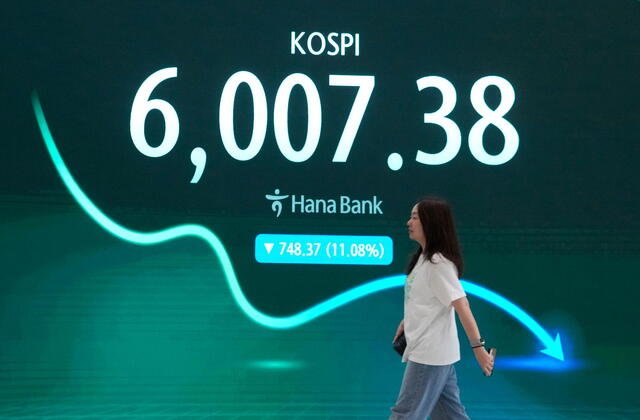
South Korea’s benchmark KOSPI stock index has just suffered its worst two-day decline on record. The index fell as much as 12.6% on Wednesday, adding to a nearly 11% drop the day before, and is now down more than 40% from a peak it reached only about a month ago.
Key Facts
- The KOSPI dived as much as 12.6% on Wednesday before paring losses to close down 6%, on top of Tuesday’s nearly 11% drop.
- SK Hynix shares slumped as much as 20% before recovering some ground to close down 9.6%, even after reporting a six-fold jump in quarterly profit to a record 60.5 trillion won, about $41.2 billion.
- Samsung Electronics fell as much as 14% before trimming losses to close down 5.2%.
- Samsung and SK Hynix together make up more than half of the KOSPI’s total market value.
- South Korea’s finance minister apologized for the earlier introduction of leveraged single-stock ETFs and said the government is reviewing market stabilization measures.
Why a Record Profit Still Triggered a Selloff
It seems strange that SK Hynix’s stock would crash after reporting record profit, but the size of a company’s earnings only tells part of the story. Investors compare results against what they were already expecting, not just against the company’s own history. SK Hynix’s profit jumped sixfold from a year earlier, yet it still fell short of the sky-high forecasts Wall Street and Korean analysts had built around the AI memory chip boom. When results miss inflated expectations, even genuinely strong numbers can trigger a sharp selloff, especially in a stock that had already climbed dramatically on hopes for even bigger results.
How Borrowed Money Made the Crash Worse
A major reason this selloff has been so extreme comes down to leverage, meaning money borrowed to buy stocks. Many small retail investors in South Korea bought into the AI chip rally using borrowed funds through leveraged ETFs, a type of fund that multiplies both gains and losses. When SK Hynix and Samsung started falling, those leveraged positions lost value fast. Brokers then issued margin calls, forcing investors to sell shares to cover their loans. Trading volumes were described as light even during the crash, suggesting many buyers had already stepped away, which left the market with fewer people willing to catch falling shares and slow the decline.
A Rally Built on Two Stocks
The scale of this crash is tied directly to how narrow the rally behind it was. South Korea’s stock market posted one of the best performances in the world earlier this year, but that surge relied almost entirely on Samsung Electronics and SK Hynix, the two companies supplying memory chips for AI data centers. When a market’s gains are concentrated in just a couple of stocks, a stumble in either one has an outsized effect on the entire index. That’s a different pattern than a broad-based selloff across many sectors, and it explains why the KOSPI has fallen so much further than most other major markets this week.
How This Connects to the Broader AI Trade
This selloff didn’t happen in isolation. Memory chip stocks in the U.S., including Micron and Western Digital, had surged in recent days on the same AI demand story that lifted Samsung and SK Hynix. That rally and this crash are two sides of the same trade: investors betting heavily that AI data center demand will keep pushing memory chip prices higher. SK Hynix’s results show that demand is real, with profit up sixfold, but this week is a reminder that when a trade gets this crowded and this leveraged, even good news can fail to meet the bar investors have set.
How Korea’s Government Is Responding
South Korean officials have moved quickly to address the crash. Finance Minister Koo Yun-cheol apologized during a parliamentary session for approving leveraged single-stock ETFs, the borrowing-heavy funds that made this week’s losses so much steeper for everyday investors. He said regulators underestimated how much these products would amplify risk during a downturn. The government is now reviewing potential stabilization measures, including tighter rules on leveraged ETFs, though officials haven’t announced specific changes yet. The Korea Exchange also briefly suspended program selling during the worst of Wednesday’s drop, a step exchanges take to slow automated trading when losses accelerate too quickly.
How This Compares to Past Corrections
A 40% decline from a recent peak in just a matter of weeks is an extreme move, even by the standards of volatile markets. Most stock market corrections, a term used for a drop of 10% or more, take months to unfold rather than days. What makes this different is the concentration and leverage involved: a rally built almost entirely on two stocks, amplified by borrowed money, can reverse far faster than a broad-based bull market built on hundreds of companies across many industries. Traders interviewed by Bloomberg and Reuters this week described the speed of the reversal, not just its size, as the most unusual part of the current selloff.
What Happens Next
Whether the KOSPI stabilizes from here likely depends on two things: whether forced selling from leveraged positions has mostly run its course, and whether upcoming earnings from other AI-linked companies reinforce or ease doubts about chip demand. Since much of this week’s decline was driven by margin calls rather than a fundamental change in the AI chip growth story, some analysts expect the market could stabilize once leveraged positions are largely cleared out. Others caution that confidence, once shaken this sharply, tends to take longer to rebuild than it took to break.
How the KOSPI Got Here
To understand why this crash matters so much, it helps to know how the KOSPI got so high in the first place. The index spent much of the year climbing toward record territory, eventually topping 9,000, driven almost entirely by excitement over Samsung and SK Hynix’s role supplying high-bandwidth memory chips used in AI data centers. Samsung began mass production of its next-generation HBM4 chips this year for shipment to major U.S. chipmakers, and investors piled in expecting years of strong demand ahead. That optimism pushed valuations for both companies well above their historical norms. The current crash hasn’t erased the underlying business, SK Hynix’s profit is still up sixfold from last year, but it has erased much of the extra value investors had added on top of that business in anticipation of even faster growth.
Why Individual Investors Got Hit Hardest
South Korea has an unusually large base of retail, or individual, investors compared with many other major markets, and a significant share of that trading happens through leveraged products and margin accounts. That matters here because leverage doesn’t just amplify losses for the investor who used it, it can also intensify the overall market decline. As losing positions get automatically sold off to cover loans, that selling adds more downward pressure on the same stocks, which can trigger further margin calls in a self-reinforcing cycle. Institutional investors, including pension funds and foreign asset managers, tend to have more risk controls in place and less exposure to this kind of forced selling, which is part of why individual investors have borne the brunt of this week’s losses.
What This Means for Investors
If you hold international or emerging market funds, it’s worth checking how much exposure they have to South Korean chipmakers, since a two-day, 40%-from-peak decline in a major index can meaningfully affect fund performance. The bigger lesson from this crash isn’t really about South Korea specifically. It’s about how leverage amplifies moves in both directions, and how a rally concentrated in just a couple of stocks can unwind just as fast as it built. Diversified investors who weren’t concentrated in AI-linked chip stocks have far less exposure to a swing like this one.
Sources
- AP News — South Korea’s Kospi Share Index Falls, Other Asian Shares Mostly Lower
- Bloomberg — Korean Stocks Tumble a Second Day as SK Hynix Results Disappoint
- Reuters via Investing.com — South Korea Stock Rout Breaks Records as SK Hynix Earnings Disappoint
This article is for general information and is not investment advice. Talk to a licensed financial advisor before making investment decisions.
Related reading: our coverage of memory chip stocks surging on AI demand looks at the U.S. side of the same trade now unwinding in Korea, and our Nasdaq selloff coverage tracks how AI valuation worries have been building globally.

Sarah Mitchell covers U.S. and global stock markets for Wall Street Sights, focusing on how earnings, Federal Reserve policy, and macroeconomic events move major indexes.