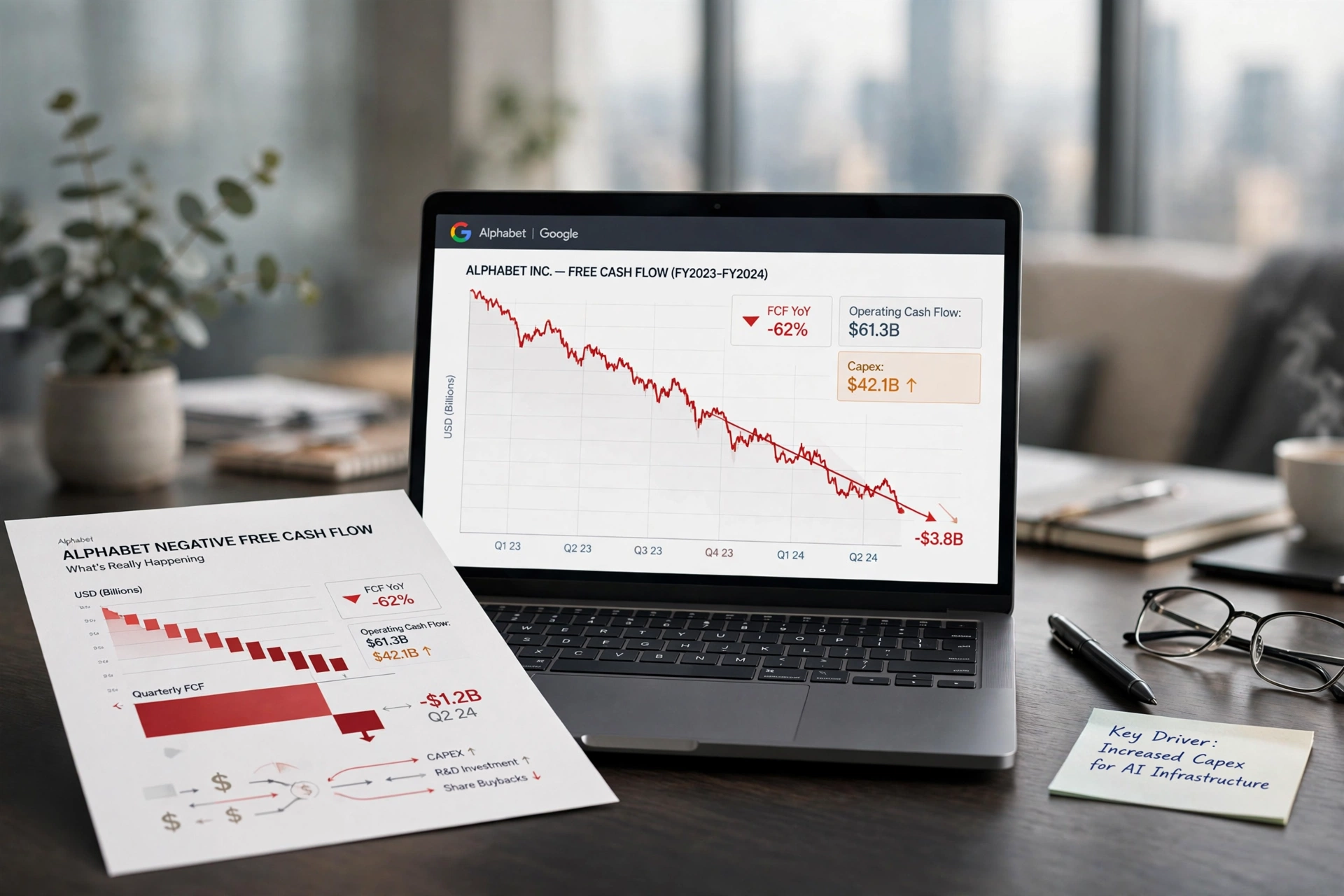
Alphabet posted negative free cash flow for the first time since its 2004 IPO, a milestone that sounds alarming on its own. But the same earnings report showed revenue up 24% and a massive profit beat, which makes this a more complicated story than the headline number suggests.
Key Facts
- Alphabet’s free cash flow came in at negative $5.9 billion for the second quarter of 2026, its first quarterly deficit since going public.
- Revenue rose 24% year-over-year to $119.8 billion, beating analyst estimates of $116.9 billion.
- Google Cloud revenue jumped 82% to $24.8 billion, with cloud operating income tripling.
- Capital expenditures nearly doubled to $44.9 billion, almost entirely tied to AI infrastructure.
- Alphabet raised its full-year 2026 capex guidance to as much as $205 billion, up from $180 billion to $190 billion previously.
Why Free Cash Flow Went Negative
Free cash flow is a simple calculation: cash generated from normal business operations, minus money spent on capital investments like buildings and equipment. Alphabet’s operations generated $39.1 billion in cash during the quarter, a strong number on its own. But the company spent $44.9 billion building out AI infrastructure, mostly data centers and computing hardware. Subtract one from the other and you get a $5.9 billion shortfall. This isn’t a sign the core business is struggling. It’s what happens when a highly profitable company chooses to spend more on growth than it’s currently bringing in.
Why Alphabet’s Own Profit Number Looked So Strong
Alphabet’s earnings per share came in far above what Wall Street expected, but a large share of that beat came from an unrealized gain on investments, not from the core advertising and cloud business. That’s an important distinction: reported profit and actual cash generated by the business aren’t the same thing, and this quarter is a clear example of why. Search advertising revenue still grew a solid 17% to $63.3 billion, showing the core business remains healthy even as the AI spending story dominates the conversation.
The Part of the Story Most Headlines Skipped
Nearly every headline about this quarter led with the scary framing: negative cash flow for the first time ever. Fewer mentioned that Alphabet’s trailing twelve-month free cash flow, a broader measure that smooths out single-quarter swings, is still a positive $53.3 billion. A single negative quarter during a period of unusually heavy investment is very different from an ongoing cash burn problem. Alphabet also raised roughly $70 billion through stock and bond sales during the quarter, giving it plenty of financial flexibility to keep funding its AI buildout without straining its balance sheet.
Alphabet Isn’t Alone in This Spending Race
Combined 2026 capital spending across Amazon, Microsoft, Meta, and Alphabet is expected to reach roughly $725 billion, up 77% from the prior year, almost entirely driven by AI infrastructure. Meta reports its own earnings shortly, and some analysts expect it could show a similar cash flow squeeze, since Meta is spending heavily on AI without the cloud business that helps offset Alphabet’s and Microsoft’s costs. This quarter is less a one-company story and more an early look at how the entire AI infrastructure race is starting to show up in Big Tech’s cash flow statements.
What This Means for Investors
A single negative free cash flow quarter isn’t automatically a red flag, especially for a company still growing revenue by double digits and generating tens of billions in operating cash. The more useful question for investors isn’t whether Alphabet spent a lot this quarter, it’s whether that spending eventually turns into the cloud contracts and AI revenue the company is betting on. Alphabet’s cloud backlog, contracted revenue not yet recognized, stood at $514 billion at quarter’s end, a number worth watching in future earnings reports as a sign of whether this spending is paying off.
This article is for general information and is not investment advice. Talk to a licensed financial advisor before making investment decisions.
Sources
- Search Engine Journal — Alphabet Q2 Earnings Show $5.85 Billion Negative Free Cash Flow
- FourWeekMBA — Alphabet’s Q2 2026 Free Cash Flow Turned Negative as AI Capex Doubled
- Drawpie — What Alphabet’s Q2 Numbers Actually Showed
Related reading: our coverage of Visa’s AI-driven job cuts and memory chip stocks surging on AI demand track other ways the AI spending boom is reshaping big companies this year.

Sarah Mitchell covers U.S. and global stock markets for Wall Street Sights, focusing on how earnings, Federal Reserve policy, and macroeconomic events move major indexes.