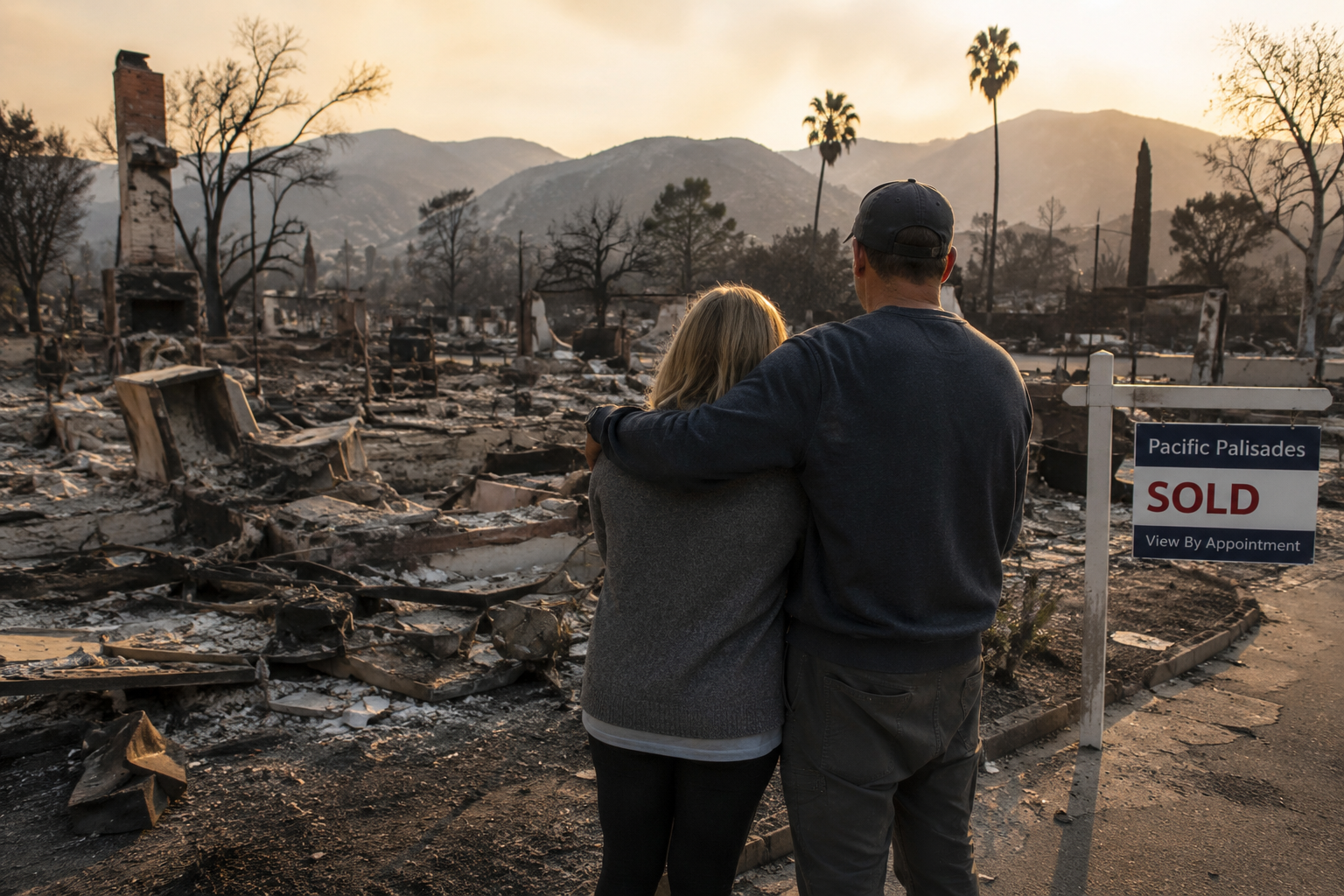
It has been 482 days. Nearly 16 months of rented rooms, scattered routines, and the quiet grief that comes from watching your neighborhood — the streets, the neighbors, the coffee shops, all of it — exist only in your memory.
But on a warm Monday morning in May 2026, Alisa Ruby Bash stood outside a brand-new front door at her Pacific Palisades address and did something she had been dreaming about since January 7, 2025: she walked back in.
The California family’s return home after the Palisades Fire is one of the first completed rebuilds in the fire zone — and it offers a rare, hopeful window into what recovery actually looks like for the thousands of Los Angeles families still waiting for theirs.
The Night the Palisades Fire Changed Everything
It started the way many California wildfire stories do — suddenly, and without enough warning.
On January 7, 2025, the Palisades Fire ignited in the hills above Pacific Palisades, one of Los Angeles’ most beloved coastal communities. Driven by powerful Santa Ana winds and years of drought, the blaze tore through neighborhoods with a ferocity that left little behind. Within days, it had consumed more than 6,000 structures across 37 square miles of the city. Alongside the simultaneously burning Eaton Fire in Altadena, the fires collectively destroyed more than 16,000 buildings across Los Angeles County, killed at least 31 people, and forced tens of thousands of families to flee with whatever they could carry.
Alisa Ruby Bash and her family were among those who had to run.
When the evacuation order came, they left. They had no way of knowing whether they’d have a home to come back to. Hours later, they found out they wouldn’t.
The Palisades Fire consumed their house — and everything in it.
What 482 Days of Displacement Looks Like
For most people, the concept of “displacement” sounds temporary. A few weeks, maybe a couple of months. But the reality facing thousands of LA wildfire survivors has been far more relentless.
Survey data collected by CalMatters found that seven in ten insurance policyholders affected by the Palisades and Eaton fires had not moved back into their homes as of early 2026 — a full year after the disaster. Permitting delays, insurance disputes, skyrocketing construction costs, and a backlogged regulatory system all conspired to extend the nightmare.
As of February 2026, the city of Los Angeles had received over 3,500 permitting applications for fire-affected properties, yet had issued completed certificates of occupancy for only a handful of rebuilt homes near the Palisades. What survivors thought would be a months-long ordeal had stretched into something far longer — and far more exhausting.
The emotional toll is harder to quantify. “Even though people are still alive, everybody was scattered everywhere,” Bash has said. “Just complete destruction to everything that we knew.”
That’s not just the loss of a house. It’s the loss of a community — the shared rhythms, familiar faces, and the invisible sense of belonging that makes a place feel like yours.
How the Bash Family Rebuilt — and What They Did Differently
Even amid the chaos of displacement, Bash knew almost immediately what she wanted to do: rebuild.
That decision, straightforward as it sounds, is anything but simple in the post-fire landscape of Los Angeles. Insurance battles, contractor shortages, material costs inflated by simultaneous demand across fire-hit neighborhoods, and a permitting process that — even with state-mandated reforms — moves slowly. Governor Gavin Newsom and Los Angeles Mayor Karen Bass both ordered expedited permitting for like-for-like rebuilds early in 2025, and analysts said those changes helped speed up the process relative to past disasters. Still, the majority of destroyed homes remain vacant lots.
For the Bash family, however, rebuilding wasn’t just about getting back to what they had. It was about building something better — and safer.
Working with Design Equity founder and CEO Abe Roy, the family’s new Pacific Palisades home was engineered specifically with fire resistance as its foundation. The design choices went far beyond cosmetics.
“There are no odd nooks and crannies where embers can be trapped, and eddy currents can form,” Roy explained. “The exterior of the house is multi-layered cement and stucco with layers of fire coating on it that provides many hours of resistance at high temperatures.”
Among the fire-conscious features built into the new home:
- No attics or crawlspaces — common entry points where embers settle and ignite
- No exposed lumber on the exterior facade
- Multi-layered cement and stucco exterior with thermal fire-resistant coating
- Non-flammable vegetation planned for the surrounding landscape
- An enclosed structure for trash cans to prevent ignition from dumpster fires — a small but sobering detail that shows how thoroughly the family has absorbed the lessons of what happened
The address is the same. But the house is an entirely new creation, built for a world where wildfire is not an anomaly but a recurring threat.
A Buddhist Blessing and a Ribbon Cutting: The Day They Finally Came Home
Before Bash walked through that front door, she wanted to do something meaningful.
She had a Buddhist monk come and bless the house.
Throughout the 16-month ordeal, Bash drew on an unexpected source of comfort: the philosophy of Tibetan sand mandalas. These are intricate, painstakingly crafted works of art — created grain by grain, sometimes over days — that are then ritually destroyed once complete. The cycle of creation, dissolution, and renewal became a kind of private metaphor for what her family was living through.
Something precious had been destroyed. But the act of making it again, with intention and care, was itself the point.
“It feels very surreal, and I’m beyond excited,” Bash said on the day her family moved back in. “And it’s just so crazy that we’re actually back here now.”
There is still more work to be done — some building and landscaping remains incomplete. The surrounding neighborhood is still a construction zone, with cleared lots and skeletal frames dotting streets that once looked very different. That, too, carries its own complicated emotion.
“Even though people are still alive, everybody was scattered everywhere,” Bash reflected. The return home brings hope — but it also brings grief for the community that no longer exists in the form they remembered it.
Where Los Angeles Wildfire Recovery Stands in 2026
The Bash family’s homecoming is a milestone, but it is also, for now, an exception.
The January 2025 fires have been called the most expensive natural disaster in California history. Swiss Re, the global reinsurer, estimated insured losses alone at $40 billion, making the fires the costliest catastrophe worldwide in 2025. UCLA researchers put total economic losses — insured and uninsured — as high as $131 billion.
Governor Newsom has sought $34 billion in federal disaster relief. Litigation between survivors and insurers continues to mount. State Farm General, California’s largest home insurer, faces dual investigations from the state and county over its claims handling. The California FAIR Plan — the state’s insurer of last resort — is accused in lawsuits of unlawfully withholding payments for smoke damage. Both deny wrongdoing.
For families without the resources, the insurance coverage, or the luck to move quickly, the road home stretches far longer than 16 months.
Of the more than 22,500 homes destroyed in California’s five most destructive fires between 2017 and 2020, fewer than four in ten had been rebuilt by 2025, according to a Los Angeles Times analysis. Historical data from comparable disasters — in Maui, Paradise, and Redding — showed reconstruction rates of just 2% to 15% one year after the fires.
Against that backdrop, the Bash family’s return is remarkable. And it is, perhaps, the shape of what is possible for others — even if the path to get there remains steep.
The Insurance Crisis That’s Keeping Thousands From Coming Home
It is impossible to tell the story of LA wildfire recovery without confronting California’s insurance crisis head-on.
In the months before the 2025 fires, several major insurers had already quietly pulled back from California, citing wildfire risk. When the fires hit, many survivors discovered that their coverage was with the FAIR Plan — a last-resort insurer offering more limited protection — or that their policies fell significantly short of what rebuilding actually costs in 2025 and 2026, when labor and material prices are elevated across the entire fire zone simultaneously.
A survey conducted in late 2025 found that four in ten insurance policyholders in the affected areas had experienced “insurability issues” — including massive premium increases and dropped coverage. State law mandates a one-year moratorium on policy cancellations after a gubernatorial state of emergency, but that protection is time-limited. Premiums for all California homeowners — not just fire survivors — are expected to rise significantly in the coming years under reforms introduced by Insurance Commissioner Ricardo Lara.
The message for California families is uncomfortable but clear: even if your home didn’t burn, the financial aftershocks of this disaster will reach you.
What California Families Rebuilding After California Wildfires Should Know
For the thousands of Pacific Palisades and Altadena families still working toward their own homecoming, the Bash family’s experience offers several practical lessons:
- Move on insurance claims immediately. Families who received insurance payments quickly — like Craig Forrest, another Palisades family who contacted Progressive the same day the fire destroyed their home — were able to move through the rebuilding process faster than those whose claims dragged on.
- Understand your policy limits before a crisis. Many survivors discovered their policies didn’t cover full replacement costs in a high-demand rebuild environment. Know your coverage ceiling now, not after a disaster.
- Explore like-for-like rebuild permits. State and city officials have streamlined permitting for rebuilds that match the approximate footprint and specifications of the destroyed home. These permits process faster than new designs.
- Build with fire resistance in mind. The next generation of homes in fire-prone zones must be designed differently. Features like enclosed eaves, fire-rated materials, ember-resistant vents, and defensible landscaping are no longer optional — they are the cost of living safely in Southern California.
- Look into community resources. Organizations like Enterprise Community Partners and local relief groups have been working to support equitable recovery, particularly for lower-income survivors who fall through the cracks of insurance systems designed for property owners.
One Family Home — And What It Means for a Community Still Healing
Standing outside her rebuilt home on that May morning, Alisa Ruby Bash was already thinking beyond herself.
She looked at the construction activity on neighboring lots and felt something she hadn’t felt in a long time: hope. Not the fragile, desperate hope of displacement — but the grounded, effortful hope that comes from watching something real being built, brick by brick, on streets you know by heart.
The community that existed before January 7, 2025, is gone. That community — its particular mix of people, relationships, rhythms, and routines — cannot be exactly reconstructed. That loss is real, and it is not erased by a ribbon cutting or a Buddhist blessing or a beautiful new facade.
But something else is being built in its place. Slowly. House by house, permit by permit, decision by decision. A new Pacific Palisades is emerging from the ash — fire-resistant, deliberately designed, hard-won.
And at one address, on one particular street, a family finally came home.
Read More-
Anne Hathaway Expecting Baby No. 3: Actress Shares Exciting Family News
Andy Burnham’s Victory Sparks Leadership Challenge Threat to UK Prime Minister Keir Starmer
Source : wsj.com
How long does it take to rebuild a home after a California wildfire?
Rebuilding timelines vary significantly depending on insurance, permitting, and contractor availability. The Palisades Fire family featured in this story took approximately 16 months — around 482 days — to rebuild and move back in. This is faster than the national average; historical data shows fewer than 40% of homes destroyed in California’s major fires between 2017–2020 had been rebuilt within several years of the disaster.
What is the current state of LA wildfire recovery in 2026?
As of mid-2026, the majority of the 16,000-plus homes destroyed in the January 2025 Palisades and Eaton fires remain unoccupied or unbuilt. Permitting has accelerated relative to past disasters, but insurance disputes, construction costs, and financial gaps continue to delay recovery for most families. Estimates put insured losses at $40 billion and total economic losses as high as $131 billion.
How do you build a fire-resistant home in California?
Fire-resistant home construction focuses on eliminating ember entry points (no open eaves, attics, or crawlspaces), using non-combustible exterior materials (cement, stucco, fire-rated coatings), avoiding exposed lumber on the exterior, and surrounding the home with non-flammable vegetation and enclosed waste storage. These features can provide hours of additional resistance during a wildfire event.
What insurance options do California wildfire victims have?
California homeowners may be covered under private insurers, surplus lines policies, or the California FAIR Plan (the state’s insurer of last resort). After a declared state of emergency, state law prohibits insurers from canceling or non-renewing policies for one year. Survivors facing denied or delayed claims can file complaints with the California Department of Insurance or pursue legal action.
How many homes have been rebuilt after the 2025 LA fires?
As of early 2026, only a small number of homes had received certificates of occupancy in the Palisades fire zone. The Bash family’s rebuild was among the first completed in the area. The city had issued over 1,900 permits but had far fewer completed rebuilds, reflecting the gap between permit approval and finished construction.

Gulraj Ansari covers personal finance for Wall Street Sights, including retirement planning, credit, and everyday money decisions for U.S. readers.