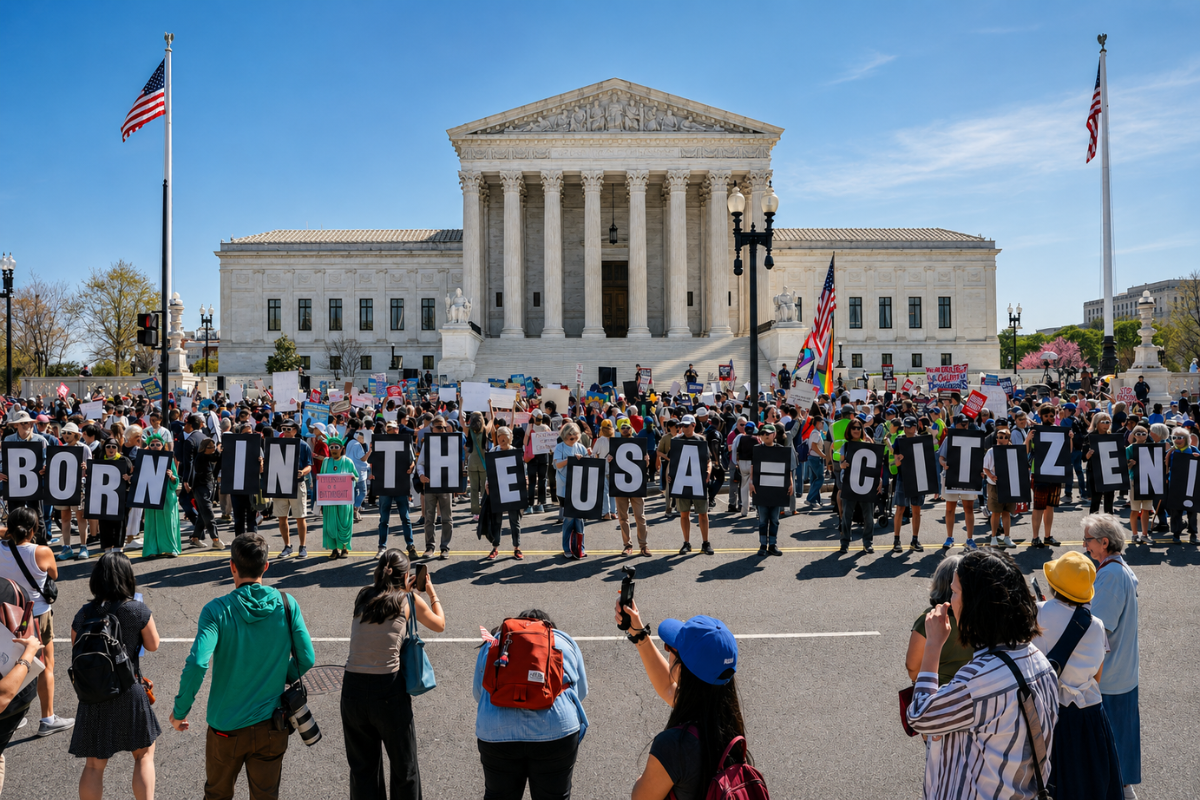
The Supreme Court is set to rule on Trump’s birthright citizenship order, a major case that could reshape U.S. immigration law and the meaning of the 14th Amendment.
Quick Answer
Birthright citizenship means most children born in the United States automatically become U.S. citizens. The Supreme Court is now reviewing President Donald Trump’s order that would limit that rule for children born to parents who are undocumented or only temporarily in the country. The decision could become one of the most important immigration rulings in modern U.S. history.
Supreme Court Faces a Major Citizenship Question
The U.S. Supreme Court is preparing to decide a major case about birthright citizenship, one of the oldest and most important rules in American law.
At the center of the case is President Donald Trump’s executive order that seeks to deny automatic citizenship to some children born in the United States. Under the order, a child born on U.S. soil would not automatically be treated as a citizen if neither parent is a U.S. citizen or lawful permanent resident.
That would be a major change from the way the 14th Amendment has long been understood.
For more than a century, birthright citizenship has meant that almost anyone born in the United States becomes a citizen at birth. There are narrow exceptions, such as children of foreign diplomats or enemy forces. But for most families, the rule has been simple: born in America, citizen of America.
Trump’s order challenges that understanding.
What Is Birthright Citizenship?
Birthright citizenship is the legal rule that gives citizenship to a person because of where they are born.
In the United States, this rule comes from the 14th Amendment. The key part says that all people born or naturalized in the United States, and subject to its jurisdiction, are citizens of the United States and the state where they live.
This language was added after the Civil War. It was meant to make sure formerly enslaved people and their children could not be denied citizenship.
Over time, the rule became a central part of American identity. It meant that citizenship was not only based on blood, race, family background, or immigration status. It was also based on birth on U.S. soil.
What Trump’s Order Would Do
Trump’s executive order takes a narrower view.
It says the U.S. government should not recognize citizenship for certain children born in the country if their parents do not have permanent legal ties to the United States.
The order mainly targets two groups.
The first group includes children born to mothers who are in the country illegally, if the father is not a U.S. citizen or lawful permanent resident.
The second group includes children born to mothers who are in the country legally but temporarily, such as on a student visa, work visa, tourist visa, or similar short-term status, if the father is also not a citizen or green-card holder.
The Trump administration argues that the phrase “subject to the jurisdiction” in the 14th Amendment does not cover everyone born in the United States. It says citizenship should depend on stronger legal allegiance to the country.
Critics say that argument rewrites the Constitution without Congress or a constitutional amendment.
Why This Case Matters Now
This case matters because it could change the legal status of many children born in the United States.
If Trump’s order is allowed to take effect, hospitals, state agencies, passport offices, schools, and families could face major confusion. Parents may need to prove their own immigration status before a child can be recognized as a citizen.
That could turn a basic birth record into a legal fight.
The case also comes at a time when immigration is one of the biggest issues in U.S. politics. Trump has made border security and immigration restrictions a central part of his agenda. Supporters say stronger rules are needed to protect citizenship and stop abuse of the system.
Opponents say the order would punish children for their parents’ status and weaken a constitutional guarantee that has existed for generations.
The 14th Amendment Fight
The legal fight is focused on one phrase: “subject to the jurisdiction thereof.”
Trump’s side says that phrase means more than simply being subject to U.S. laws. The administration argues it requires a deeper form of allegiance to the United States.
Opponents say that reading is too narrow. They argue that nearly everyone living in the United States is subject to U.S. laws, including undocumented immigrants and temporary visa holders. Their children, they say, are therefore covered by the 14th Amendment if born on U.S. soil.
This is why the case is so important. It is not only about immigration policy. It is about the meaning of the Constitution.
The Wong Kim Ark Precedent
A major part of the debate is an 1898 Supreme Court case called United States v. Wong Kim Ark.
Wong Kim Ark was born in San Francisco to Chinese parents who were not U.S. citizens. The Supreme Court ruled that he was a U.S. citizen because he was born in the United States.
Supporters of birthright citizenship say this case settled the issue long ago.
The Trump administration argues the case does not fully answer today’s question because Wong’s parents were living in the United States with a stronger permanent connection than some temporary visitors or undocumented immigrants.
That difference is now part of the Supreme Court’s review.
What Happened in Lower Courts?
Lower courts blocked Trump’s order before it could fully take effect. Judges said the order likely conflicted with the plain meaning of the 14th Amendment and long-standing legal precedent.
The case then moved toward the Supreme Court.
In an earlier related decision, the Supreme Court limited the power of federal judges to issue nationwide injunctions. But that ruling did not decide whether Trump’s birthright citizenship order itself was constitutional.
Now, the justices are being asked to address the deeper question: can a president restrict birthright citizenship through executive action?
What Could Happen Next?
There are several possible outcomes.
The Supreme Court could reject Trump’s order and keep the long-standing birthright citizenship rule in place.
It could uphold part or all of the order, giving the federal government more power to deny citizenship at birth in certain cases.
It could also issue a narrower ruling that leaves some questions open and sends parts of the dispute back to lower courts.
Any of those outcomes would be important. A broad decision could reshape citizenship law for years. A narrow ruling could keep the legal fight going.
Political Impact
The ruling will likely become a major political issue.
For Trump and his supporters, limiting birthright citizenship is part of a larger immigration crackdown. They argue the current system encourages illegal immigration and “birth tourism.”
For Democrats, immigrant-rights groups, and many legal scholars, the order is an attack on the 14th Amendment and the idea that children born in the United States should not inherit legal punishment from their parents.
The decision also comes near July 4, making the timing especially symbolic. The country is debating what it means to be American just as it prepares to celebrate its founding.
Final Takeaway
The birthright citizenship case is one of the most important Supreme Court battles of the year.
At stake is more than one immigration order. The case asks whether a president can change a rule that has shaped American citizenship for more than a century.
If the Court blocks Trump’s order, birthright citizenship will remain largely unchanged. If the Court allows the order to move forward, the United States could enter a new era where a child’s citizenship depends more directly on the legal status of their parents.
For families, hospitals, states, and immigration lawyers, the ruling could bring major changes.
For the country, it could redefine who is considered American at birth.
FAQ
What is birthright citizenship?
Birthright citizenship means a person becomes a citizen because they are born in a country. In the U.S., it is tied to the 14th Amendment.
What is Trump trying to change?
Trump’s order seeks to deny automatic citizenship to some children born in the U.S. if their parents are undocumented or only temporarily in the country.
Has the Supreme Court ruled yet?
As of the latest sources checked, the Court was expected to rule, but the final decision had not yet appeared in the available reports.
What is the 14th Amendment?
The 14th Amendment says people born or naturalized in the United States, and subject to its jurisdiction, are citizens.
Why is Wong Kim Ark important?
The 1898 Supreme Court case United States v. Wong Kim Ark is widely viewed as a key precedent supporting birthright citizenship for children born in the U.S. to foreign parents.
Could this affect babies born in the U.S.?
Yes. Experts cited by Reuters estimated Trump’s directive could affect the legal status of as many as 250,000 babies born each year.
Can a president end birthright citizenship alone?
That is the central legal question. Critics say only a constitutional amendment or Congress can change such a rule. The Trump administration argues the Constitution has been misunderstood.

Gulraj Ansari covers personal finance for Wall Street Sights, including retirement planning, credit, and everyday money decisions for U.S. readers.