A monthly budget gives every dollar a purpose. It helps you pay bills on time, control unnecessary spending, build emergency savings, reduce debt and prepare for long-term goals.
Budgeting does not mean removing everything enjoyable from your life. A good budget allows you to spend on the things that matter while protecting you from financial stress.
This complete Budgeting Guide 2026 explains how to create a realistic monthly budget, choose the right budgeting method, manage irregular income, reduce expenses and stay consistent without feeling restricted.
Quick Answer
A budget is a written plan showing how much money you expect to receive and how you plan to use it. To create a monthly budget, calculate your after-tax income, list fixed and variable expenses, set savings and debt goals, subtract expenses from income and adjust the plan until every important need is covered.
A simple budget might divide income among necessities, savings, debt payments and personal spending. The best budget is not necessarily the strictest one. It is the plan you can follow consistently.
Key Takeaways
- A budget helps you decide where your money should go before it is spent.
- Use after-tax or take-home income when building a personal budget.
- Separate essential expenses from optional spending.
- Include savings and debt payments as planned budget categories.
- The 50/30/20 rule is simple, but it may not fit every household.
- Zero-based budgeting gives every dollar a specific purpose.
- Irregular expenses should be divided into monthly sinking-fund contributions.
- Track actual spending and compare it with your plan each week.
- A budget should change when your income, expenses or priorities change.
- Small, sustainable improvements are usually better than extreme cuts.
Table of Contents
- What Is a Budget?
- Why Budgeting Matters
- How to Create a Monthly Budget
- Monthly Budget Template
- Popular Budgeting Methods
- The 50/30/20 Budget Rule
- Zero-Based Budgeting
- Pay-Yourself-First Budget
- Envelope Budgeting
- Fixed and Variable Expenses
- Needs vs. Wants
- Sinking Funds
- Budgeting With Irregular Income
- Budgeting for Couples and Families
- How to Reduce Monthly Expenses
- Saving and Paying Off Debt
- Budgeting Tools
- Common Budgeting Mistakes
- Monthly Budget Routine
- Frequently Asked Questions
What Is a Budget?
A budget is a plan for your income and expenses during a specific period. Most personal budgets cover one month because many bills, paychecks and financial statements follow a monthly cycle.
A budget answers four important questions:
- How much money is coming in?
- How much money must be spent?
- How much can be saved or invested?
- How much is available for optional purchases?
Without a budget, people often make financial decisions one purchase at a time. A restaurant meal, subscription or online order may seem affordable on its own. However, many small purchases can quietly consume the money needed for larger priorities.
A budget shows the complete picture. It helps you understand the effect of every financial decision on your bills, savings and future goals.
A budget is not the same as expense tracking
Expense tracking shows where your money already went. Budgeting decides where your money should go before you spend it.
Both activities are important. Tracking helps you understand your habits, while budgeting helps you change them.
Why Is Budgeting Important?
Budgeting creates financial awareness. It allows you to see whether your current income can support your lifestyle and goals.
1. It helps you pay bills on time
A budget lists upcoming expenses and due dates. This reduces the chance of missed payments, late fees and service interruptions.
2. It prevents overspending
Spending limits help you recognize when one category is using too much of your income. You can make adjustments before the problem becomes serious.
3. It helps build emergency savings
Unexpected costs are easier to handle when savings are already included in your monthly plan.
Our Emergency Fund Guide 2026 explains how much emergency savings you may need and where to keep the money.
4. It supports debt repayment
A budget shows how much extra money can be directed toward credit cards, personal loans, auto loans or student debt.
5. It makes long-term goals possible
Major goals rarely happen by accident. Buying a home, starting a business, traveling or preparing for retirement normally requires regular saving over many months or years.
6. It reduces financial stress
A budget cannot solve every money problem, but it can replace uncertainty with a clear plan. Knowing what you can afford often reduces anxiety and improves financial decision-making.
How to Create a Monthly Budget in Eight Steps
Step 1: Calculate your monthly take-home income
Start with the money that reaches your bank account after taxes, insurance premiums, retirement deductions and other payroll deductions.
Possible income sources include:
- Salary or wages
- Overtime
- Bonuses
- Freelance income
- Business income
- Tips and commissions
- Child support or alimony received
- Pension income
- Social Security benefits
- Rental income after related costs
- Other reliable monthly income
Do not include uncertain money until you actually receive it. Depending on an expected bonus, tax refund or commission can create a budget shortage if the payment is delayed or smaller than expected.
Step 2: Review recent spending
Look at the last two or three months of bank statements, credit-card statements and payment-app records.
Write down what you actually spent instead of estimating from memory. Many people underestimate food delivery, shopping, convenience purchases and subscriptions.
Step 3: List fixed expenses
Fixed expenses usually remain similar each month.
Examples include:
- Rent or mortgage
- Car payment
- Insurance premiums
- Phone plan
- Internet service
- Childcare
- Minimum loan payments
- Memberships and subscriptions
Step 4: Estimate variable expenses
Variable expenses change from month to month.
Examples include:
- Groceries
- Electricity and gas
- Fuel
- Public transportation
- Dining out
- Entertainment
- Clothing
- Personal care
- Medical costs
- Household supplies
Use an average based on recent months instead of choosing an unrealistically low number.
Step 5: Add irregular expenses
Some expenses do not happen every month but should still be included in the budget.
Examples include:
- Annual insurance premiums
- Holiday gifts
- Vehicle registration
- Home repairs
- School expenses
- Professional fees
- Vacations
- Property taxes
- Pet care
Divide the expected yearly cost by 12 and save that amount each month.
For example, if vehicle registration and maintenance are expected to cost $1,200 during the year, saving $100 per month can make those bills easier to manage.
Step 6: Set savings and debt goals
Your budget should include categories for financial progress, not only regular bills.
Possible goals include:
- Building an emergency fund
- Paying off credit-card debt
- Saving for a home down payment
- Contributing to retirement accounts
- Saving for education
- Building a travel fund
- Starting an investment account
Retirement savers can review our Complete 401(k) Guide 2026 and Roth IRA Guide 2026.
Step 7: Subtract expenses from income
Use this basic formula:
Monthly income − monthly expenses = monthly balance
If the result is positive, decide where the extra money should go. It could be added to savings, debt payments, investing or another goal.
If the result is negative, you are planning to spend more than you receive. Reduce expenses, increase income or use a combination of both.
Step 8: Track and adjust
A budget is a working plan, not a document you create once and ignore.
Compare actual spending with your budget at least once a week. Move money between categories when needed, but avoid using savings or debt-payment money for unnecessary spending.
Simple Monthly Budget Template
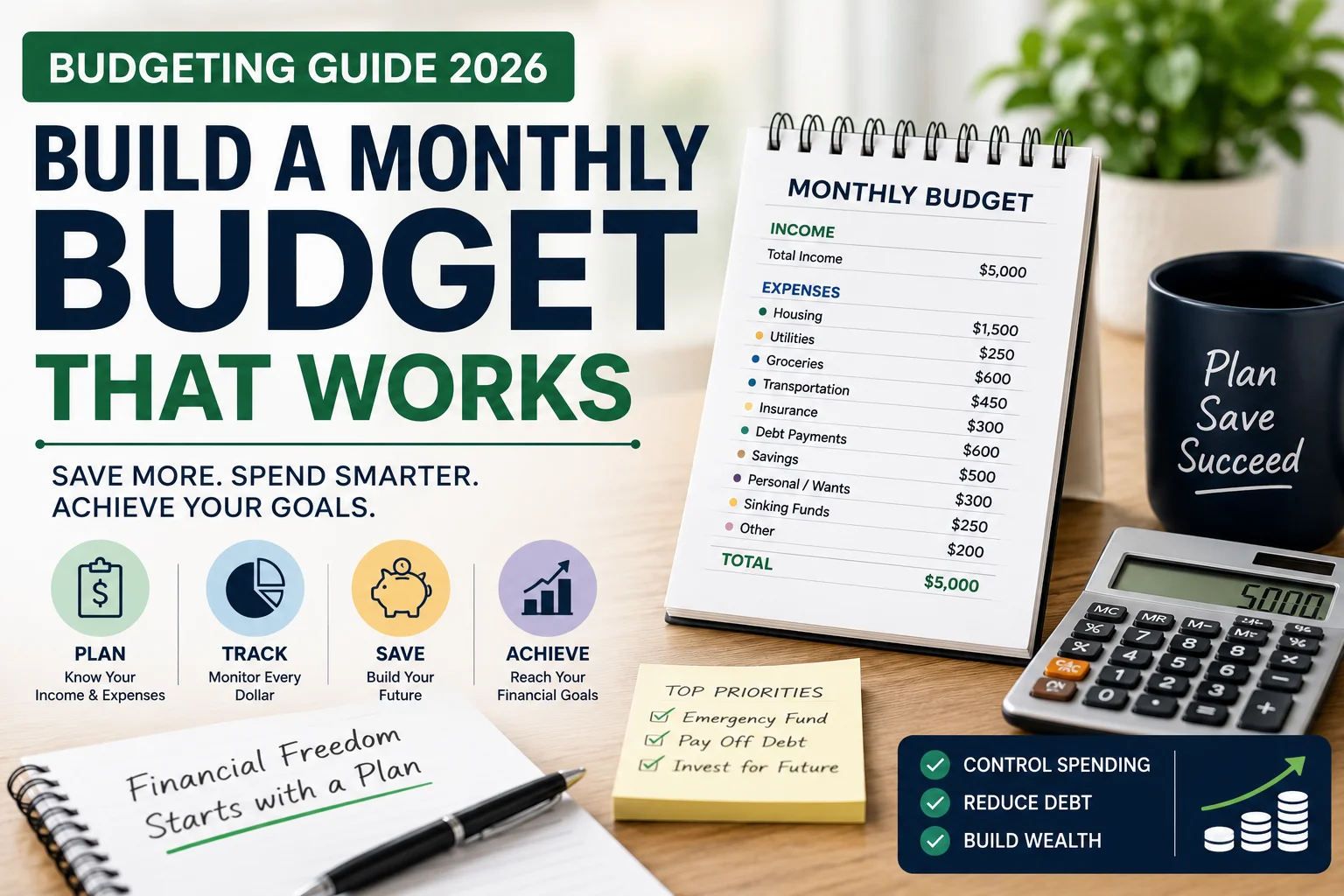
The following example shows how a household with $5,000 in monthly take-home income might organize its money.
| Budget Category | Planned Amount | Actual Amount | Difference |
|---|---|---|---|
| Monthly take-home income | $5,000 | — | — |
| Rent or mortgage | $1,500 | — | — |
| Utilities | $250 | — | — |
| Groceries | $600 | — | — |
| Transportation | $450 | — | — |
| Insurance | $300 | — | — |
| Minimum debt payments | $300 | — | — |
| Emergency savings | $300 | — | — |
| Retirement investing | $400 | — | — |
| Dining and entertainment | $300 | — | — |
| Personal and household spending | $300 | — | — |
| Sinking funds | $250 | — | — |
| Extra debt payment | $250 | — | — |
| Remaining balance | $0 | — | — |
This is only an example. Housing, childcare, healthcare and transportation costs vary widely by household and location.
The Federal Trade Commission’s consumer education website also provides a free monthly budget worksheet that allows users to list income and expenses.
Popular Budgeting Methods
There is no single budgeting system that works for everyone. The right method depends on your income, personality, responsibilities and goals.
| Budget Method | How It Works | Best For |
|---|---|---|
| 50/30/20 rule | Divides income among needs, wants and goals | Beginners wanting a simple framework |
| Zero-based budget | Assigns every dollar a purpose | People wanting detailed control |
| Pay yourself first | Moves savings before other spending | People focused on saving and investing |
| Envelope method | Creates spending limits for categories | People who struggle with overspending |
| Priority budget | Funds important goals first | Households with changing income |
| Weekly budget | Breaks monthly spending into weekly limits | People who run out of money before payday |
What Is the 50/30/20 Budget Rule?
The 50/30/20 rule divides after-tax income into three broad groups:
- 50% for needs
- 30% for wants
- 20% for savings and additional debt payments
Needs
Needs are essential expenses required for daily life and financial obligations.
Examples include:
- Housing
- Basic utilities
- Groceries
- Transportation
- Insurance
- Healthcare
- Minimum debt payments
- Essential childcare
Wants
Wants improve comfort or enjoyment but are not strictly necessary.
Examples include:
- Dining out
- Streaming subscriptions
- Vacations
- Entertainment
- Premium phone plans
- Nonessential shopping
Savings and additional debt payments
This category may include:
- Emergency-fund contributions
- Retirement contributions
- Investments
- Extra credit-card payments
- Extra loan payments
- Saving for major goals
50/30/20 example
For monthly take-home income of $4,000:
| Category | Percentage | Monthly Amount |
|---|---|---|
| Needs | 50% | $2,000 |
| Wants | 30% | $1,200 |
| Savings and extra debt payments | 20% | $800 |
When the 50/30/20 rule may not work
The rule can be difficult in an expensive city where housing alone uses more than half of take-home income. It may also be unsuitable for someone aggressively paying off debt or saving for an urgent goal.
Treat the percentages as a starting point, not a law. A household might use 60/20/20, 70/10/20 or another division that reflects its circumstances.
What Is Zero-Based Budgeting?
Zero-based budgeting assigns every dollar of income to a category until the amount left to assign equals zero.
The formula is:
Income − spending − saving − debt payments = $0
A zero balance does not mean spending every dollar. Money assigned to savings and investments is also part of the plan.
Zero-based budget example
A person receiving $4,000 per month may assign:
- $2,300 to essential expenses
- $600 to savings and investing
- $500 to debt payments
- $400 to personal spending
- $200 to sinking funds
The total assigned amount equals the full $4,000 income.
Advantages
- Provides detailed control
- Makes financial priorities clear
- Reduces unexplained spending
- Works well for aggressive saving or debt repayment
Disadvantages
- Requires regular tracking
- Can feel time-consuming at first
- May require frequent changes when income varies
What Is the Pay-Yourself-First Budget?
The pay-yourself-first method moves money to savings or investments before optional spending begins.
For example, a worker may automatically transfer 15% of each paycheck to retirement savings, an emergency fund or another goal. The remaining money is then used for bills and personal expenses.
This method works because savings happen automatically instead of depending on whatever money remains at the end of the month.
Example order
- Receive paycheck.
- Transfer money to savings and investments.
- Pay essential bills.
- Use the remaining amount for flexible spending.
This approach is simple, but you still need to ensure that enough money remains for housing, food, transportation and minimum debt obligations.
What Is the Envelope Budgeting Method?
The envelope method creates a spending limit for each category. Traditionally, people placed cash into labeled envelopes for groceries, fuel, entertainment and other expenses.
When an envelope became empty, spending in that category stopped until the next budget period.
Today, the same idea can be used through:
- Separate bank accounts
- Budgeting apps
- Prepaid cards
- Digital spending categories
- Cash envelopes
Who may benefit?
The envelope method may help people who regularly overspend in flexible categories such as dining, shopping and entertainment.
It may be less convenient for automatic bills or online purchases, so many households use a mixture of digital and cash envelopes.
Fixed Expenses vs. Variable Expenses
Understanding the difference between fixed and variable expenses makes budgeting easier.
| Fixed Expenses | Variable Expenses |
|---|---|
| Rent or mortgage | Groceries |
| Car payment | Electricity |
| Insurance premium | Fuel |
| Phone plan | Dining out |
| Loan payment | Entertainment |
| Childcare fee | Clothing |
Why the difference matters
Variable expenses are usually easier to change quickly. You may be able to reduce dining, shopping or entertainment this month.
Fixed expenses often require larger decisions, such as moving to a less expensive home, refinancing a loan, changing insurance or canceling a service contract.
However, reducing one major fixed expense can have a greater long-term effect than cutting many small purchases.
How to Separate Needs From Wants
A need is something essential for health, safety, work or basic financial obligations. A want is something that improves comfort, convenience or enjoyment.
The category can depend on the situation.
For example:
- A basic phone may be a need, while the newest premium model is a want.
- Food is a need, while frequent restaurant delivery is generally a want.
- Transportation to work is a need, while a luxury vehicle may be a want.
- Internet access may be a need for work, while several streaming services are wants.
The goal is not to remove every want. A realistic budget includes enjoyable spending in an amount that does not damage essential goals.
What Is a Sinking Fund?
A sinking fund is money saved gradually for a known future expense.
Unlike an emergency fund, a sinking fund is used for costs you expect.
Common sinking-fund categories
- Vehicle maintenance
- Home repairs
- Holiday gifts
- Travel
- School costs
- Medical deductibles
- Annual insurance premiums
- Technology replacement
- Pet expenses
- Professional fees
How to calculate a sinking fund
Use this formula:
Expected cost ÷ months until payment = monthly saving amount
Suppose you expect to spend $1,800 on a vacation in nine months:
$1,800 ÷ 9 = $200 per month
Saving $200 each month means the trip can be paid for without using high-interest debt.
How to Budget With Irregular Income
Freelancers, commission-based workers, business owners and seasonal workers may not receive the same income each month.
Budgeting is still possible, but the plan needs a stronger safety margin.
1. Find your baseline income
Review the last 6 to 12 months and identify a conservative monthly income amount. You might use the lowest regular month rather than the average.
2. Build a bare-bones budget
List the minimum amount required for:
- Housing
- Utilities
- Food
- Transportation
- Insurance
- Healthcare
- Minimum debt payments
3. Create an income buffer
Save part of stronger-income months to support weaker months. Keeping one month of income in a separate buffer account can make cash flow more predictable.
4. Prioritize money in order
When income arrives, use it in this order:
- Essential expenses
- Taxes for self-employment income
- Minimum debt payments
- Emergency savings
- Future bills and sinking funds
- Retirement savings
- Optional spending
5. Review the plan more often
Irregular earners may need to update their budget after every payment instead of only once a month.
How Couples and Families Can Budget Together
A household budget works best when everyone affected by it understands the plan.
Discuss goals before numbers
Start by agreeing on priorities such as:
- Paying off debt
- Buying a home
- Building emergency savings
- Funding education
- Taking a vacation
- Preparing for retirement
Shared goals make spending limits easier to understand.
Choose how accounts will be managed
Couples may use:
- Fully joint accounts
- Separate accounts
- A mixture of joint and separate accounts
No system is automatically correct. The important points are transparency, agreement and clear responsibility for bills.
Allow personal spending
Giving each partner a reasonable personal spending amount can reduce conflict. Purchases within that limit may not require discussion or approval.
Schedule a monthly money meeting
Review:
- Income received
- Bills due
- Recent spending
- Progress toward goals
- Upcoming irregular costs
- Changes needed for the next month
The discussion should focus on solving problems, not blaming one person for every budget difference.
How to Reduce Monthly Expenses Without Making Life Miserable
Budget cuts are easier to maintain when they focus on value instead of removing everything enjoyable.
Review recurring subscriptions
Check bank and credit-card statements for:
- Streaming services
- Apps
- Cloud storage
- Memberships
- Software
- Subscription boxes
- Automatic renewals
Cancel services that are rarely used.
Compare insurance and service providers
Request quotes for auto insurance, home insurance, phone service and internet. Review coverage carefully instead of choosing only the lowest price.
Plan meals before shopping
A weekly meal plan can reduce food waste, unnecessary grocery purchases and expensive last-minute delivery orders.
Use a shopping waiting period
Wait 24 to 72 hours before making a nonessential purchase. The delay can reduce impulse buying.
Reduce expensive debt costs
Paying down high-interest credit cards can lower future interest charges and free money for other goals.
Focus on major expenses
Housing, transportation and food are often the largest household categories. Improving one large expense may save more than cutting many small pleasures.
Avoid extreme cuts
A budget that removes all entertainment, social activity and personal spending may fail quickly. Keep a modest amount for enjoyment so the plan remains sustainable.
Should You Save Money or Pay Off Debt First?
Many households need to do both. The right balance depends on interest rates, job stability and available savings.
A practical order to consider
- Pay all minimum debt payments.
- Build a small starter emergency fund.
- Capture any available employer retirement match.
- Pay extra toward high-interest debt.
- Build a larger emergency fund.
- Increase retirement and investment contributions.
- Save for other major goals.
This is a general framework, not a requirement for every household.
Debt avalanche method
The debt avalanche method pays extra toward the debt with the highest interest rate while making minimum payments on the others.
This method can reduce the total interest paid.
Debt snowball method
The debt snowball method targets the smallest balance first. After one debt is paid off, its payment is added to the next debt.
This method may provide faster emotional progress, although it may cost more in interest than the avalanche method.
Retirement savings
Workers with access to employer matching should understand how much they need to contribute to receive the full match.
Our Advantages of 401(k) Plans in 2026 explains employer matching, automatic contributions and long-term retirement growth.
Best Tools for Managing a Budget
A budget can be managed using paper, a spreadsheet, a banking tool or a dedicated app.
Paper budget
A notebook or printed worksheet is simple and does not require sharing financial information with an app.
Spreadsheet
A spreadsheet allows you to customize categories, create formulas and compare several months.
Banking tools
Many banks automatically categorize transactions and show spending summaries. Review the categories because automated systems can make mistakes.
Budgeting apps
Budgeting apps may connect accounts, track transactions and send spending alerts. Before connecting financial accounts, review the company’s security practices, privacy policy and fees.
Automatic transfers
Automatic transfers can move money to savings, investments or sinking funds after each payday. Automation reduces the need to rely on memory or willpower.
Official budget worksheet
Consumer.gov offers a free budget worksheet that helps users list monthly income, housing, food, transportation, healthcare and other expenses.
Common Budgeting Mistakes to Avoid
1. Using gross income
A personal budget should normally use the money you can actually spend after taxes and payroll deductions.
2. Guessing expenses
Use statements and receipts instead of relying only on memory.
3. Forgetting irregular costs
Annual bills, repairs and holidays should be included through sinking funds.
4. Setting unrealistic spending limits
A grocery budget that is far below your normal cost may fail within the first week.
5. Treating savings as optional
Include savings as a planned category instead of waiting to see what remains.
6. Removing all personal spending
An overly strict budget can lead to frustration and overspending later.
7. Ignoring small recurring payments
Several inexpensive subscriptions can become a meaningful monthly expense.
8. Failing to communicate
A household budget may fail when only one person understands or supports it.
9. Using credit to hide a budget shortage
Credit cards can temporarily cover overspending, but interest charges may make future months more difficult.
10. Never updating the budget
Income, prices, bills and goals change. Review the budget regularly.
A Simple Monthly Budgeting Routine
Before the month begins
- Estimate expected income.
- List bills and due dates.
- Plan variable spending.
- Set savings and debt targets.
- Add upcoming irregular expenses.
Once a week
- Check account balances.
- Review recent transactions.
- Compare actual spending with category limits.
- Adjust the remaining weekly spending.
At the end of the month
- Calculate total income and spending.
- Identify categories that exceeded the plan.
- Move any remaining money to a goal.
- Prepare the next month’s budget.
Budget reset checklist
- Cancel unused subscriptions.
- Update income changes.
- Review insurance and service costs.
- Check debt balances.
- Review emergency savings.
- Increase automatic savings after a raise.
- Prepare for seasonal expenses.
30-Day Budgeting Action Plan
Week 1: Understand your money
- Collect bank and credit-card statements.
- Calculate take-home income.
- List fixed expenses.
- Identify subscriptions.
Week 2: Build the plan
- Estimate variable expenses.
- Add savings and debt categories.
- Create sinking funds.
- Choose a budgeting method.
Week 3: Track spending
- Record every purchase.
- Check category balances.
- Reduce spending where necessary.
- Avoid unplanned credit-card purchases.
Week 4: Review and improve
- Compare planned and actual spending.
- Identify one major improvement.
- Adjust unrealistic categories.
- Prepare next month’s budget.
Frequently Asked Questions About Budgeting
What is a budget in simple terms?
A budget is a plan showing how much money you expect to receive and how you intend to spend, save or invest it.
How do I start a budget for the first time?
Calculate your take-home income, list monthly expenses, set savings and debt goals, subtract expenses from income and adjust the categories until the plan is affordable.
What is the best budgeting method for beginners?
The 50/30/20 rule can be a simple starting point. People wanting more control may prefer zero-based budgeting.
What is the 50/30/20 rule?
It suggests using approximately 50% of take-home income for needs, 30% for wants and 20% for savings and additional debt payments.
What is a zero-based budget?
A zero-based budget gives every dollar a purpose so that income minus planned spending, saving and debt payments equals zero.
How much should I save each month?
The right amount depends on your income, expenses and goals. Saving any consistent amount is useful. Some frameworks suggest directing around 20% of take-home income toward savings and extra debt payments, but this may not be realistic for every household.
Should savings be included as an expense?
Yes. Treating savings as a planned budget category can make it more consistent.
How often should I review my budget?
Check spending at least once a week and complete a full review at the end of each month.
What if my expenses are higher than my income?
Separate essential and optional costs, reduce spending where possible, contact creditors or service providers when necessary and explore realistic ways to increase income.
How do I budget with irregular income?
Base essential spending on a conservative income estimate, build an income buffer and use high-income months to prepare for lower-income periods.
What is the difference between a sinking fund and an emergency fund?
A sinking fund pays for a known future expense, such as vehicle maintenance or holiday gifts. An emergency fund protects against unexpected and urgent costs.
Can a budget include entertainment?
Yes. A realistic budget can include dining, entertainment and hobbies as long as essential expenses and financial priorities remain covered.
Should couples combine all their money?
Not necessarily. Couples may use joint accounts, separate accounts or a combination. The important factors are honesty, shared goals and clear responsibility for expenses.
What should I do with money left at the end of the month?
You can add it to emergency savings, pay extra debt, invest it, fund an upcoming expense or divide it among several goals.
Does budgeting improve credit scores?
A budget does not directly change a credit score, but it can help you pay bills on time and reduce debt, which may support stronger credit over time.
Helpful Budgeting Resources
- Consumer.gov Budget Worksheet
- Consumer.gov Money Management Resources
- Consumer Financial Protection Bureau Consumer Tools
- Investor.gov Investing Basics
Continue Learning
- Emergency Fund Guide 2026
- Complete 401(k) Guide 2026
- Roth IRA Guide 2026
- Advantages of 401(k) Plans in 2026
- Beginner Investing Guide 2026
Final Thoughts
A budget is one of the most useful tools in personal finance because it connects your daily spending with your long-term goals.
You do not need a perfect spreadsheet or complicated app to begin. Start with your take-home income, list your expenses and decide what matters most. Track your results and improve the plan each month.
The first budget may not work perfectly. Grocery costs may be higher than expected, a bill may change or an irregular expense may appear. That does not mean budgeting failed. It means the next budget will be more accurate.
A successful budget is flexible enough for real life but strong enough to protect your priorities. With consistent planning, it can help you build savings, reduce debt and gain greater control over your financial future.
Educational Disclaimer
This article is provided for general educational and informational purposes only. It is not personalized financial, investment, tax, accounting or legal advice. Financial decisions should be based on your income, expenses, goals and individual circumstances. Consider consulting a qualified financial professional when necessary.

Finance Writer | Wall Street Sights
Gulraj Ansari covers U.S. markets, business, investing, artificial intelligence, and global economic trends. His reporting focuses on delivering clear, research-backed, and reader-friendly financial insights.