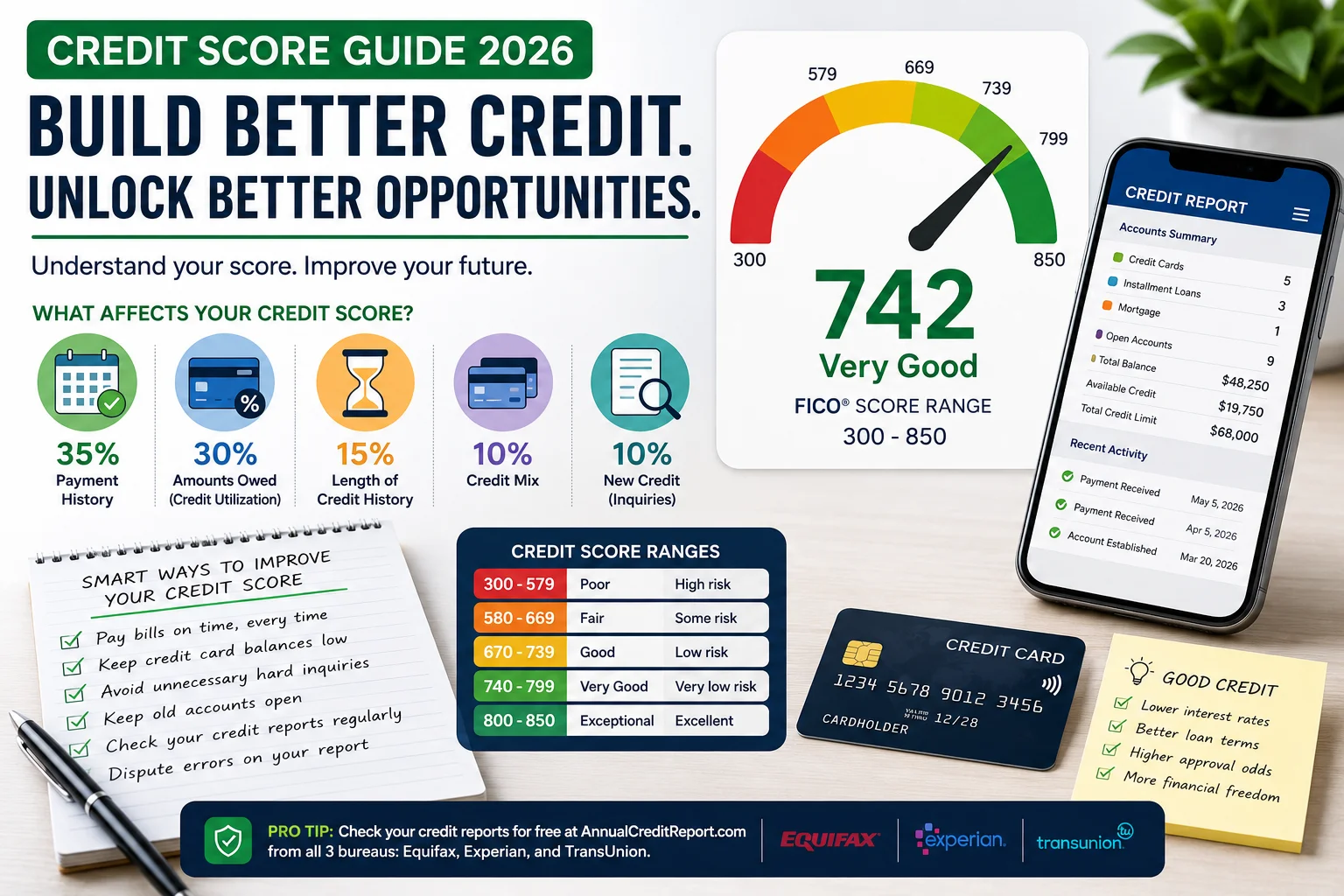
Your credit score can affect whether you qualify for a credit card, auto loan, mortgage or personal loan. It may also influence the interest rate, deposit or other terms you receive.
A higher credit score does not guarantee approval, but it can show lenders that you have managed borrowed money responsibly. A lower score may make borrowing more difficult or expensive.
This complete Credit Score Guide 2026 explains how credit scores work, the difference between a credit report and credit score, what affects your score and the practical steps you can take to build stronger credit.
Quick Answer
A credit score is a number calculated from information in your credit reports. Most base FICO scores range from 300 to 850. A higher score generally suggests a lower risk of missing future payments.
The most effective ways to improve your credit are to pay every bill on time, reduce credit-card balances, avoid unnecessary applications, keep older accounts open when practical and correct inaccurate information on your credit reports.
Credit improvement normally takes time. There is no legitimate method that can instantly remove accurate negative information or guarantee a specific score increase.
Key Takeaways
- Credit reports and credit scores are related, but they are not the same thing.
- Most base FICO scores range from 300 to 850.
- Payment history is generally the most important FICO scoring category.
- High credit-card balances can hurt your score even when payments are made on time.
- Checking your own credit report does not lower your credit score.
- A hard inquiry may have a small and temporary effect.
- You do not need to carry credit-card debt or pay interest to build credit.
- Closing an old card can affect utilization and account history.
- Accurate negative information generally cannot be removed simply because it hurts your score.
- Building excellent credit requires consistent habits over time.
Table of Contents
- What Is a Credit Score?
- Credit Report vs. Credit Score
- Credit Score Ranges
- FICO vs. VantageScore
- What Affects Your Credit Score?
- Payment History
- Credit Utilization
- Length of Credit History
- Credit Mix
- New Credit and Inquiries
- How to Check Your Credit
- How to Dispute Credit Report Errors
- How to Improve Your Credit Score
- How to Build Credit From Scratch
- What to Do After a Late Payment
- Collections and Charge-Offs
- How Debt Payoff Affects Credit
- Common Credit Score Myths
- 90-Day Credit Improvement Plan
- Frequently Asked Questions
What Is a Credit Score?
A credit score is a number designed to estimate the likelihood that a borrower will repay money as agreed. Credit-scoring companies calculate scores using information found in consumer credit reports.
Lenders may use credit scores when reviewing applications for:
- Credit cards
- Mortgages
- Auto loans
- Personal loans
- Home-equity products
- Private student loans
- Business credit requiring a personal guarantee
A credit score is only one part of a lending decision. A lender may also consider income, employment, debt obligations, down payment, assets and the type of credit being requested.
The Consumer Financial Protection Bureau provides a helpful official explanation of credit scores.
Why does your credit score matter?
Your score may influence:
- Whether an application is approved
- The interest rate offered
- The available credit limit
- The required down payment
- The need for a co-signer
- The deposit required for certain services
A strong score may help you qualify for more competitive terms, but lenders do not all use the same scoring model or approval standards.
Credit Report vs. Credit Score
A credit report is a detailed record of your credit activity. A credit score is a number calculated from information in that record.
| Credit Report | Credit Score |
|---|---|
| Detailed record of credit accounts | Three-digit risk estimate |
| Shows balances and payment history | Calculated from report information |
| May show collections and public records | Does not show every account detail |
| Created by credit-reporting companies | Created through a scoring model |
| May contain errors that can be disputed | Can change when report information changes |
What appears on a credit report?
A credit report may contain:
- Your name and identifying information
- Current and previous addresses
- Credit-card accounts
- Auto loans
- Mortgages
- Student loans
- Account opening dates
- Balances and credit limits
- Payment history
- Collection accounts
- Hard credit inquiries
- Certain public-record information
Your report does not normally include your income, savings balance or full bank-account activity.
Credit Score Ranges Explained
Most base FICO scores range from 300 to 850. FICO commonly groups scores into the following ranges:
| FICO Score | General Rating | What It May Indicate |
|---|---|---|
| 300–579 | Poor | Approval may be difficult or expensive |
| 580–669 | Fair | Some products may be available with less favorable terms |
| 670–739 | Good | Generally viewed as an acceptable credit range |
| 740–799 | Very good | May qualify for competitive offers |
| 800–850 | Exceptional | Generally reflects very strong credit management |
These categories are educational guidelines, not approval guarantees. A lender can use its own underwriting standards and may use a different score version.
You can review FICO’s official credit score range explanation.
What is considered a good credit score?
A base FICO score from 670 to 739 is generally described as good. However, the score needed for a particular loan depends on the lender, product, income, debt and other application details.
Do you need an 850 score?
No. A perfect score is not necessary to receive strong lending terms. Once your score is already in a high range, other factors may become equally or more important.
FICO Score vs. VantageScore
FICO and VantageScore are different credit-scoring systems. Both use information from credit reports, but they may weigh information differently.
This means you may see different numbers from:
- Your credit-card company
- A banking app
- A credit-monitoring service
- A mortgage lender
- An auto lender
A score difference does not automatically mean one score is wrong. The scores may come from different bureaus, models, versions or dates.
Why do lenders see a different score?
Your lender may use:
- A different credit bureau
- A newer or older model version
- An industry-specific score
- A report updated on a different day
Base FICO scores generally range from 300 to 850, while some industry-specific FICO scores use a different range.
What Affects Your Credit Score?
FICO explains its commonly cited scoring categories as follows:
| Credit Factor | Common FICO Weight |
|---|---|
| Payment history | 35% |
| Amounts owed | 30% |
| Length of credit history | 15% |
| New credit | 10% |
| Credit mix | 10% |
These percentages are general guidelines. Their effect can vary based on the information in an individual credit file.
FICO provides more detail through its official guide explaining what goes into a FICO score.
1. Payment History
Payment history is generally the most important FICO scoring category. It shows whether you paid credit obligations by their due dates.
Accounts that may affect payment history include:
- Credit cards
- Mortgages
- Auto loans
- Student loans
- Personal loans
- Retail financing
How late payments are reported
A payment that is only a few days late may create a fee, but lenders generally report delinquencies to credit bureaus in 30-day stages.
Credit reports may show payments as:
- 30 days late
- 60 days late
- 90 days late
- 120 days late or more
The more serious and recent the late payment, the more damage it may cause.
How to protect payment history
- Set automatic minimum payments.
- Create calendar reminders.
- Keep a checking-account buffer.
- Review bills every week.
- Contact the lender before missing a payment.
A realistic spending plan can make payments easier to manage. Read our Budgeting Guide 2026 to build a monthly payment plan.
2. Credit Utilization
Credit utilization measures how much revolving credit you are using compared with your available credit limits.
Use this formula:
Credit-card balance ÷ credit limit × 100 = utilization rate
For example, a $1,500 balance on a card with a $5,000 limit produces a 30% utilization rate.
| Balance | Credit Limit | Utilization |
|---|---|---|
| $500 | $5,000 | 10% |
| $1,500 | $5,000 | 30% |
| $3,500 | $5,000 | 70% |
| $5,000 | $5,000 | 100% |
What is a good utilization ratio?
Lower utilization is generally better. Many educational resources suggest keeping it below 30%, but 30% is not a magic cutoff. People seeking stronger scores may benefit from substantially lower reported balances.
Overall and individual-card utilization
Scoring models may consider:
- Your total utilization across all cards
- The utilization on each individual card
- The number of cards reporting balances
One nearly maxed-out card may hurt even if your total utilization is moderate.
How to lower utilization
- Pay balances before the statement closing date.
- Make more than one payment per month.
- Reduce unnecessary card spending.
- Request a limit increase without increasing spending.
- Spread necessary purchases across cards carefully.
- Pay down the highest-utilization account first.
3. Length of Credit History
Scoring models may consider:
- The age of your oldest account
- The age of your newest account
- The average age of all accounts
- How long particular accounts have been used
Older accounts can support a longer credit history. This is one reason to think carefully before closing an old credit card with no annual fee.
Should you keep an unused card open?
Keeping it open may help preserve available credit and account history, but there are exceptions.
Closing the card may be reasonable when:
- It charges a high annual fee.
- It encourages harmful spending.
- The terms are poor.
- You are concerned about fraud or account management.
Financial health is more important than keeping every account open solely for a score.
4. Credit Mix
Credit mix refers to the different types of accounts in your history.
These may include:
- Revolving accounts, such as credit cards
- Installment accounts, such as auto or personal loans
- Mortgages
- Student loans
- Retail credit accounts
A responsible history with different types of credit can help, but you should not borrow money merely to improve your credit mix.
Paying unnecessary interest is generally not worth a possible scoring benefit.
5. New Credit and Hard Inquiries
A hard inquiry may appear when a lender checks your credit after you apply for financing.
Hard inquiries may occur when applying for:
- A credit card
- An auto loan
- A mortgage
- A personal loan
- A private student loan
A single inquiry normally has a small effect, but several applications in a short period may create more concern.
What is a soft inquiry?
A soft inquiry may occur when:
- You check your own credit.
- A company reviews credit for a preapproved offer.
- An existing lender reviews an account.
- An employer performs an authorized review.
Soft inquiries do not affect your credit scores.
Rate shopping
Some scoring models group multiple inquiries for certain loan types, such as mortgages or auto loans, when they occur within a limited shopping period.
Complete rate shopping within a focused period instead of spreading applications across many months.
How to Check Your Credit Report for Free
The federally authorized website for requesting credit reports from Equifax, Experian and TransUnion is AnnualCreditReport.com.
Free weekly online credit reports are currently available from all three nationwide credit-reporting companies.
Why check all three reports?
Not every lender reports to every bureau. One report may contain an account or error that does not appear on the others.
What should you review?
- Names and addresses
- Accounts you do not recognize
- Incorrect late payments
- Wrong balances or limits
- Duplicate accounts
- Accounts belonging to someone else
- Old negative information that should no longer appear
- Hard inquiries you did not authorize
Does checking your own report hurt your score?
No. Requesting or reviewing your own credit report is a soft inquiry and does not lower your credit score.
How to Dispute Credit Report Errors
An error can affect your score or make it harder to qualify for credit. Dispute inaccurate information with the credit-reporting company and the business that supplied the information.
Step 1: Gather supporting documents
Possible evidence includes:
- Bank statements
- Payment confirmations
- Account statements
- Identity-theft reports
- Letters from lenders
- Court documents
Step 2: Identify the exact error
Clearly explain:
- The account involved
- The information that is wrong
- Why it is wrong
- What correction you are requesting
Step 3: Submit the dispute
You can generally submit disputes online, by mail or by phone. Keep copies of every document and record the date of submission.
Step 4: Review the result
After the investigation, review the updated report carefully. If the problem remains, provide additional documentation or consider filing a complaint with the Consumer Financial Protection Bureau.
Visit the CFPB’s credit reports and scores resource center for official guidance.
How to Improve Your Credit Score
1. Pay every account on time
Set automatic minimum payments as protection, then pay the full planned amount manually when possible.
2. Bring past-due accounts current
If you are behind, contact the lender and ask about repayment, hardship or payment-assistance options.
3. Reduce revolving balances
Lowering credit-card debt can reduce utilization and interest costs.
4. Pay before the statement date
The balance reported to credit bureaus may be the statement balance rather than the amount remaining after the due-date payment. Paying earlier may reduce the reported balance.
5. Avoid unnecessary credit applications
Apply only when the account supports a real financial need.
6. Keep older accounts open when practical
An old card with no annual fee may help preserve account age and available credit.
7. Request higher credit limits carefully
A higher limit can lower utilization if spending remains unchanged. Ask whether the request will create a hard inquiry.
8. Correct reporting errors
Removing inaccurate negative information may improve the score once reports update.
9. Build an emergency fund
Emergency savings can reduce the need to miss payments or rely heavily on credit cards during an unexpected expense.
See our Emergency Fund Guide 2026 for a step-by-step savings plan.
10. Follow a debt-repayment strategy
A budget can direct extra money toward high-interest balances while protecting minimum payments on every account.
How to Build Credit From Scratch
People without a credit history may have difficulty qualifying for traditional products. Several options can help establish a file.
Secured credit card
A secured card generally requires a refundable security deposit. Use it for small purchases and pay the statement balance in full.
Credit-builder loan
With a credit-builder loan, payments are generally made before receiving the saved funds. Confirm that the lender reports payments to the credit bureaus.
Authorized-user status
A trusted person may add you as an authorized user on a well-managed card. The effect depends on whether the issuer reports authorized users and how the primary account is managed.
Student or starter card
Some issuers offer products designed for students or people with limited history. Compare fees and interest rates carefully.
Reported rent or utility payments
Some services can report rent or other recurring payments. Review costs, bureau coverage and cancellation terms before enrolling.
Best beginner habit
Use a small percentage of the available limit, allow the statement to generate and pay the full statement balance by the due date.
What to Do After a Late Payment
If the payment is less than 30 days late
Pay it immediately and contact the lender. You may owe a late fee, but the account may not yet have been reported as delinquent.
If the payment has been reported
- Bring the account current.
- Set automatic payments.
- Ask about hardship assistance.
- Continue paying every account on time.
- Review reports to ensure the information is accurate.
Can you request a goodwill adjustment?
You can ask a lender to remove an isolated late payment as a goodwill gesture, especially when you have an otherwise strong history. The lender is not required to approve the request.
Do not dispute accurate information by claiming it is an error.
Collections, Charge-Offs and Credit Scores
A collection can appear when an unpaid debt is transferred or sold to a collection company. A charge-off means the original creditor has treated the account as a loss, but the debt may still be owed.
Before paying a collection
- Confirm the debt belongs to you.
- Verify the amount.
- Check the age of the debt.
- Request written information.
- Understand applicable state law.
- Keep proof of every payment.
Paying a collection does not guarantee that it will disappear from a credit report. The scoring impact depends on the model, account type, age and reporting status.
Be careful with old debt
Making a payment or promise on an old debt may affect legal time limits in some states. Consider qualified legal advice when dealing with old or disputed debt.
How Paying Off Debt Affects Your Credit Score
Paying down credit-card balances can often help by lowering utilization.
Paying off an installment loan may cause a temporary score change because the account mix and active-loan information change. This does not mean paying off debt was a bad financial decision.
Debt avalanche
The debt avalanche method targets the highest interest rate first while maintaining minimum payments on all other accounts.
Debt snowball
The debt snowball method targets the smallest balance first to create faster visible progress.
Choose the method you are most likely to follow consistently. The Budgeting Guide 2026 can help you identify money available for extra payments.
Common Credit Score Myths
Myth 1: Checking your credit lowers your score
Reality: Checking your own report or score is a soft inquiry and does not lower it.
Myth 2: You must carry a balance
Reality: You do not need to carry debt or pay interest to build credit. Paying the statement balance in full can build positive payment history.
Myth 3: Income is part of your credit score
Reality: Income is not normally included in the score calculation, although lenders may consider it separately.
Myth 4: Closing a card always improves credit
Reality: Closing a card can reduce available credit and increase utilization.
Myth 5: Marriage combines credit scores
Reality: Married people maintain separate credit files and scores. Joint accounts can affect both reports.
Myth 6: Paying a collection removes it automatically
Reality: Paying changes the account status but does not always remove the record.
Myth 7: Everyone has one credit score
Reality: A person can have many scores based on different models, bureaus and dates.
Myth 8: Credit repair companies can erase accurate history
Reality: Accurate negative information generally cannot be legally removed simply because it is harmful.
90-Day Credit Improvement Plan
Days 1–30: Review and stabilize
- Request all three credit reports.
- Dispute inaccurate information.
- List every balance, limit and due date.
- Set automatic minimum payments.
- Bring small past-due accounts current.
- Stop unnecessary applications.
Days 31–60: Reduce utilization
- Target the card with the highest utilization.
- Make weekly balance payments.
- Pause optional card spending.
- Apply extra budget money to revolving debt.
- Request limit increases when appropriate.
Days 61–90: Build stronger systems
- Create a starter emergency fund.
- Review new credit-report updates.
- Keep all accounts current.
- Cancel only accounts that create real costs or risks.
- Continue debt payments.
- Check progress without expecting an exact score increase.
Some consumers may see changes quickly after balances update. Others may need several months or longer, especially when rebuilding after serious delinquencies.
Frequently Asked Questions About Credit Scores
What is a good credit score in 2026?
A base FICO score from 670 to 739 is generally considered good. Different lenders may use different standards.
What is the highest credit score?
The highest base FICO score is 850. Some industry-specific scores use different ranges.
What is the lowest credit score?
The lowest base FICO score is 300.
How fast can a credit score improve?
It depends on what is affecting the score. Lower reported balances may help relatively quickly, while rebuilding after missed payments can take much longer.
Does paying bills early improve credit?
Paying before the statement closing date can reduce the reported card balance. The main priority is to avoid missing the due date.
Does paying rent build credit?
Rent can help when payments are reported to a credit bureau and included by the scoring model being used.
Does checking your credit hurt your score?
No. Checking your own credit is a soft inquiry.
How many credit cards should I have?
There is no ideal number for everyone. Keep only the number you can manage responsibly without missing payments or overspending.
Should I close a paid-off credit card?
Not automatically. Keeping a no-fee account open may help preserve available credit and account history.
Does carrying a credit-card balance help?
No. Carrying a balance can create interest costs and is not required to build credit.
Can you have a credit score without a credit card?
Yes. Installment loans or other reported accounts can establish a credit history, although a well-managed revolving account may help create a broader file.
Why did my score drop after paying off a loan?
The active-account mix or installment balance changed. A temporary decline does not mean paying off debt was financially harmful.
Can a credit-repair company guarantee a score increase?
No legitimate company can guarantee a particular score or legally remove accurate negative information on demand.
How often should I check my credit report?
Review reports regularly and before applying for major financing. Free weekly online reports are currently available.
Do spouses share credit scores?
No. Each spouse has an individual credit history. Joint accounts may appear on both reports.
Official Credit Resources
- CFPB: Credit Reports and Scores
- AnnualCreditReport.com
- Federal Trade Commission: Understanding Your Credit
- FICO Credit Score Education
- Submit a CFPB Complaint
Continue Learning
- Budgeting Guide 2026
- Emergency Fund Guide 2026
- Traditional IRA Guide 2026
- Roth IRA Guide 2026
- Complete 401(k) Guide 2026
Final Thoughts
A strong credit score is built through ordinary actions repeated over time. Paying bills by their due dates, keeping card balances low and applying for credit carefully can have a greater effect than complicated credit tricks.
Start by reviewing all three credit reports. Correct errors, create a reliable payment system and reduce the balances closest to their limits.
Do not become discouraged by monthly score changes. Different scoring services can show different numbers, and balances may update at different times. Focus on the habits and report information behind the score.
Strong credit is not the final goal by itself. It is a financial tool that may help you borrow at a lower cost and keep more money available for savings, investing and other priorities.
Educational Disclaimer
This article is provided for general educational and informational purposes only. It is not personalized financial, credit, legal or tax advice. Credit-scoring formulas, lender standards and consumer laws can change. Consider contacting a qualified financial counselor, attorney or other professional regarding your individual circumstances.

Gulraj Ansari covers personal finance for Wall Street Sights, including retirement planning, credit, and everyday money decisions for U.S. readers.