WASHINGTON, D.C. — Imagine spending years doing everything right. You followed the rules, went through the legal process, got your green card, built a life in America.
You own a business, pay your taxes, raise your kids here. Then one day you take a short trip abroad to visit family — and when you come back home, a border officer stops you and says you’re no longer being treated as a permanent resident.
That scenario just became a lot more possible.
On June 23, 2026, the U.S. Supreme Court ruled 6-3 that border officers can take away a green card holder’s permanent resident status at the border — based on nothing more than an accusation, even if the person has never been convicted of anything.
The decision affects an estimated 13 million green card holders living across the United States right now.
So What Exactly Happened?
The case is called Blanche v. Lau, and it started all the way back in 2012 with a man named Muk Choi Lau.
Lau was a green card holder from China, living legally in the United States. He was accused — not convicted, just accused — of selling fake clothing in New Jersey. Before his trial even started, he took a short trip to China. When he came back through JFK Airport in New York, a border officer stopped him and placed him on what’s called “immigration parole.”
That might sound minor, but it’s a really big deal. Being put on parole meant the government stopped treating Lau as someone who already lived here. Instead, they treated him like a stranger trying to get into the country for the first time. That one change made it much easier for the government to deport him.
Lau said that wasn’t fair or legal. He fought it in court for years. His case eventually made it all the way to the highest court in the land.
And he lost.
What the Six Judges in the Majority Said
Six of the nine Supreme Court justices — all appointed by Republican presidents — sided with the Trump administration.
Justice Clarence Thomas wrote the main opinion. He said border officers shouldn’t be required to have solid proof of a crime before putting a green card holder on parole. Officers at the border have to make fast decisions, he argued, and the law doesn’t require them to clear a high bar of evidence before acting.
In simple terms: a border officer’s suspicion is enough. You don’t have to be proven guilty. You don’t even have to be charged yet. A suspicion is enough to put your entire legal status in jeopardy the moment you step off a plane.
What the Three Dissenting Judges Said
Not everyone agreed — and the three judges who disagreed were pretty upset about it.
Justice Ketanji Brown Jackson, joined by Justices Sonia Sotomayor and Elena Kagan, wrote a sharp dissent. She warned that the ruling hands the government way too much power over people who earned their legal status fair and square.
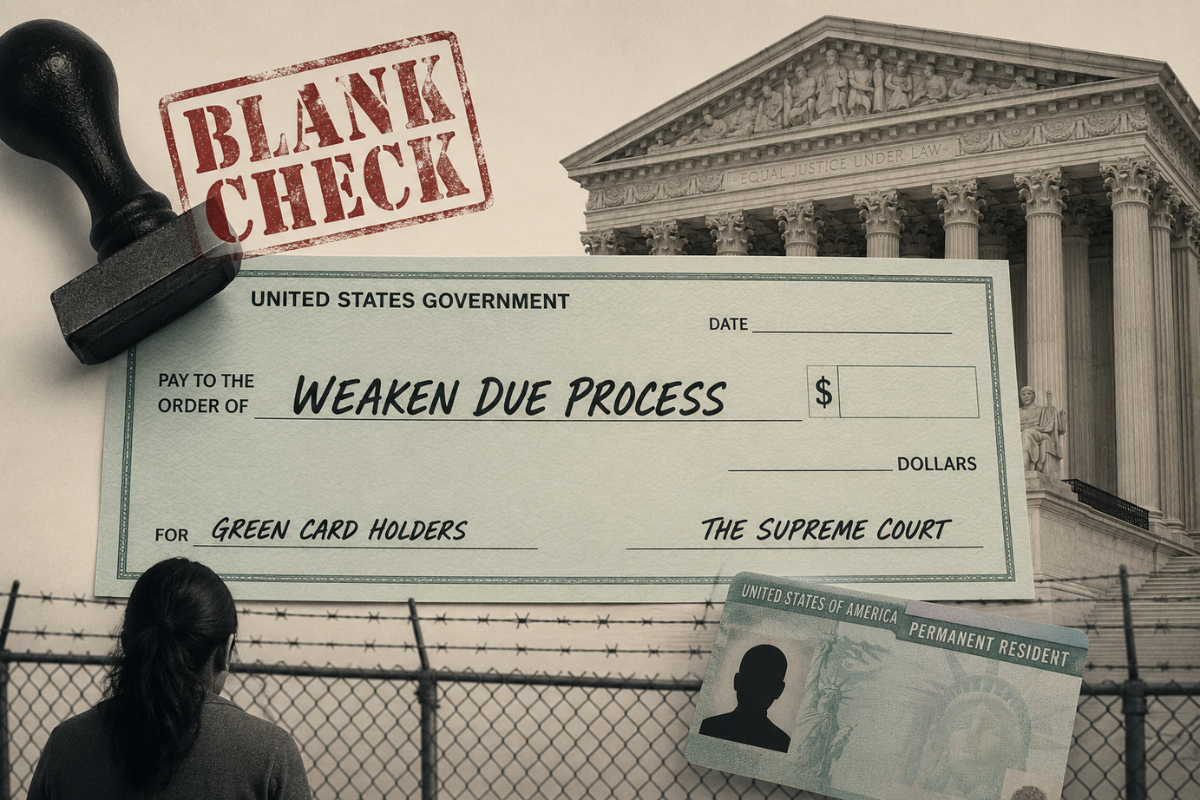
“I worry that the Court has now handed the Government a massive blank check,” Jackson wrote.
She pointed out that green card holders are, legally speaking, “as close to citizenship as one can get” without actually being a citizen. They have real rights. They built real lives. And now, she argued, those rights can be taken away at the border based on an unproven accusation, with almost no way to fight back in court.
“Today, the majority ignores that crucial fact,” she wrote, “and empowers Government officials to act accordingly.”
Why Does This Matter for Real People?
Think about what a green card actually represents. It’s not handed out easily. People wait years — sometimes over a decade — to get one. They pass background checks, pay fees, go through interviews, and prove they deserve to be here.
And yet, under this ruling, all of that can be put on hold the moment they land at an American airport after a trip abroad — if a border officer decides something looks suspicious.
Here’s the really important part: you don’t have to be guilty of anything. You don’t have to have been convicted. You don’t even need to have been formally charged. An allegation — a rumor, an old accusation, a pending case — is now enough.
Once that happens, the government can move much faster to start deportation proceedings. And the decision is nearly impossible to challenge in court.
Cities like New York, Los Angeles, Houston, Chicago, and Miami — home to millions of green card holders — could see real, everyday families caught up in this.
The Trump Administration Called It a Win
The Department of Homeland Security was thrilled with the ruling.
DHS’s top lawyer, James Percival, said the Court had “affirmed an important tool DHS has long used to prevent criminals from entering our country.”
The ruling fits neatly into the Trump administration’s broader push to give the government more power over immigration. It came the same day a federal court in Washington, D.C. also gave the green light to the administration’s fast-track deportation program.
For the administration, it was a very good day.
What Green Card Holders Should Do Right Now
If you or someone you know has a green card, here’s the bottom line:
Before you travel internationally, talk to an immigration lawyer — especially if there’s any unresolved legal issue in your past, no matter how minor it seems. An old charge, a pending case, even something you thought was closed could put you at risk at the border.
A few things to keep in mind:
- This ruling does not affect you while you’re inside the United States. Your green card is still valid here.
- The risk kicks in when you re-enter the country after traveling abroad.
- It doesn’t matter how many times you’ve traveled before without a problem. Under this ruling, every return trip is a fresh risk.
- Make sure your paperwork is organized and up to date before any international trip.
The rules of the game just changed. Knowing that might be the most important thing of all.
Read more :
China’s Gaokao 2026: Why 12.9 Million Students Took the World’s Toughest Exam
Anne Hathaway Expecting Baby No. 3: Actress Shares Exciting Family News
AMC Announces $200 Million Stock Offering to Reduce Debt and Boost Liquidity
Source : Motherjones.com

Sarah Mitchell covers U.S. and global stock markets for Wall Street Sights, focusing on how earnings, Federal Reserve policy, and macroeconomic events move major indexes.