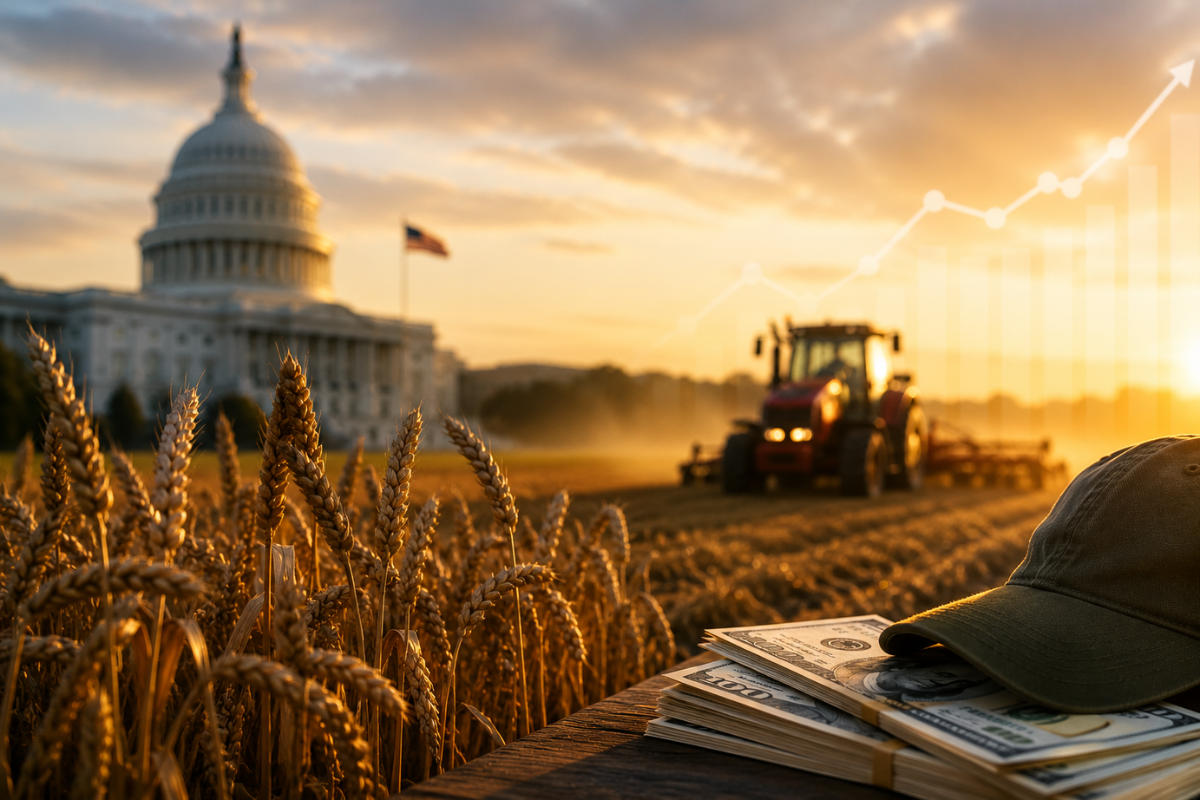
U.S. Farm Subsidies : A massive wave of government support for American farmers is taking shape in 2026 — and it’s sparking a heated national debate over whether U.S. agriculture is being stabilized… or slowly becoming dependent on Washington.
New projections from the U.S. Department of Agriculture suggest that federal payments to farmers could reach $44 billion next year, already one of the highest levels in history. On top of that, an additional $11 billion emergency funding request has been proposed in Congress, pushing total potential support close to $55 billion.
If approved, it would mark one of the largest farm aid packages ever assembled in modern U.S. history.
🌾 Why U.S. Farmers Need More Support Right Now
Across America’s farming regions, economic pressure is stacking up fast.
Farmers are dealing with a difficult mix of:
- Falling crop prices for corn and soybeans
- Rising fuel and fertilizer costs
- Oversupply after record harvests
- Global instability impacting trade and energy costs
Even after strong harvests, profits are shrinking. More supply in the market has pushed prices down — especially for corn and soybeans — while production costs remain stubbornly high.
The result: many farmers are producing more… but earning less.
📉 A Growing Reliance on Government Money
What makes this moment unusual is not just the size of the proposed aid — but how central government payments have become to farm income.
Over the past decade, federal support has expanded through:
- Trade war compensation payments
- COVID-19 emergency relief
- Crop price safety-net programs
- Conservation and disaster assistance
- Biofuel-driven demand policies
USDA data shows that government payments are now responsible for a significant share of total farm income, especially during downturns.
Some analysts say this has helped prevent a deeper rural financial crisis. Others warn it has changed how farming itself works.
⚠️ “We’ve Become Dependent”: Economists Raise Concerns
Not everyone agrees that rising subsidies are healthy for the long term.
Agricultural economists argue that constant government intervention can:
- Keep unprofitable farms operating longer than the market would allow
- Encourage overproduction of already-saturated crops
- Delay necessary market corrections
- Increase long-term reliance on federal aid
One analyst described the situation bluntly:
“At some point, low prices have to fix low prices.”
The concern is that instead of adjusting supply naturally, subsidies may be keeping production higher than demand can support.
🚜 Farmers Are Split — Relief vs Reality
On the ground, farmers have mixed feelings.
Many acknowledge they rely on government support to survive volatile seasons. Others say they don’t want it — but have no choice.
Some farmers argue the payments are essential to:
- Keep farms financially stable
- Protect rural communities
- Maintain U.S. food production capacity
Others worry the system is becoming unsustainable, with older generations relying too heavily on government checks instead of saving during profitable years.
The result is a growing divide inside farm country itself.
🌽 Not All Agriculture Is Struggling Equally
The impact is uneven across the industry.
- Corn & Soybeans: pressured by oversupply and falling prices
- Rice & Cotton: long-term profitability challenges
- Cattle Ranching: currently strong due to tight supply and higher beef prices
This uneven recovery highlights how fragile agricultural markets can be — even within the same sector.
⚡ Beyond Subsidies: Hidden Forces Supporting Farm Income
Government support doesn’t come only in the form of direct payments.
Other policies also shape farm profitability, including:
- Biofuel mandates increasing demand for corn and soybeans
- Energy policy affecting diesel and fertilizer costs
- Trade policy influencing export demand
These indirect supports often play just as large a role as direct subsidies.
🌍 The Bigger Question: What Happens Next?
The debate now goes beyond short-term aid.
At stake is a bigger question:
👉 Is U.S. agriculture being stabilized… or structurally reshaped by government support?
Supporters say the system protects food security and rural livelihoods during global instability.
Critics argue it risks locking agriculture into a cycle where markets no longer fully determine outcomes.
🔑 Key Takeaways
- U.S. farm aid could approach $55 billion in 2026
- Farmers face falling crop prices and rising costs
- Government support is now a major share of farm income
- Economists are divided on long-term impacts
- Some crops are struggling while cattle remains strong
- Debate is growing over subsidy dependency vs stability
Read More
Wealthy Father’s Multi-Million-Dollar Football Dream Ends in Controversy
❓ FAQs
Why are U.S. farmers getting more aid?
Because crop prices are falling while costs like fuel and fertilizer remain high.
How much government support is being discussed?
Around $44B projected plus a possible $11B emergency request.
Which crops are most affected?
Corn and soybeans are facing the most pressure from oversupply.
Are all farmers struggling?
No, cattle producers are currently doing relatively well.
Why are economists concerned?
They believe subsidies may distort market behavior and encourage overproduction.

Emily Rodriguez covers corporate earnings, deals, and company news for Wall Street Sights, with a focus on what business decisions mean for investors and consumers.