Update: Alan Greenspan died in June 2026 at age 100. Read our coverage of his death and legacy.
Table of Contents
Alan Greenspan Biography
Introduction
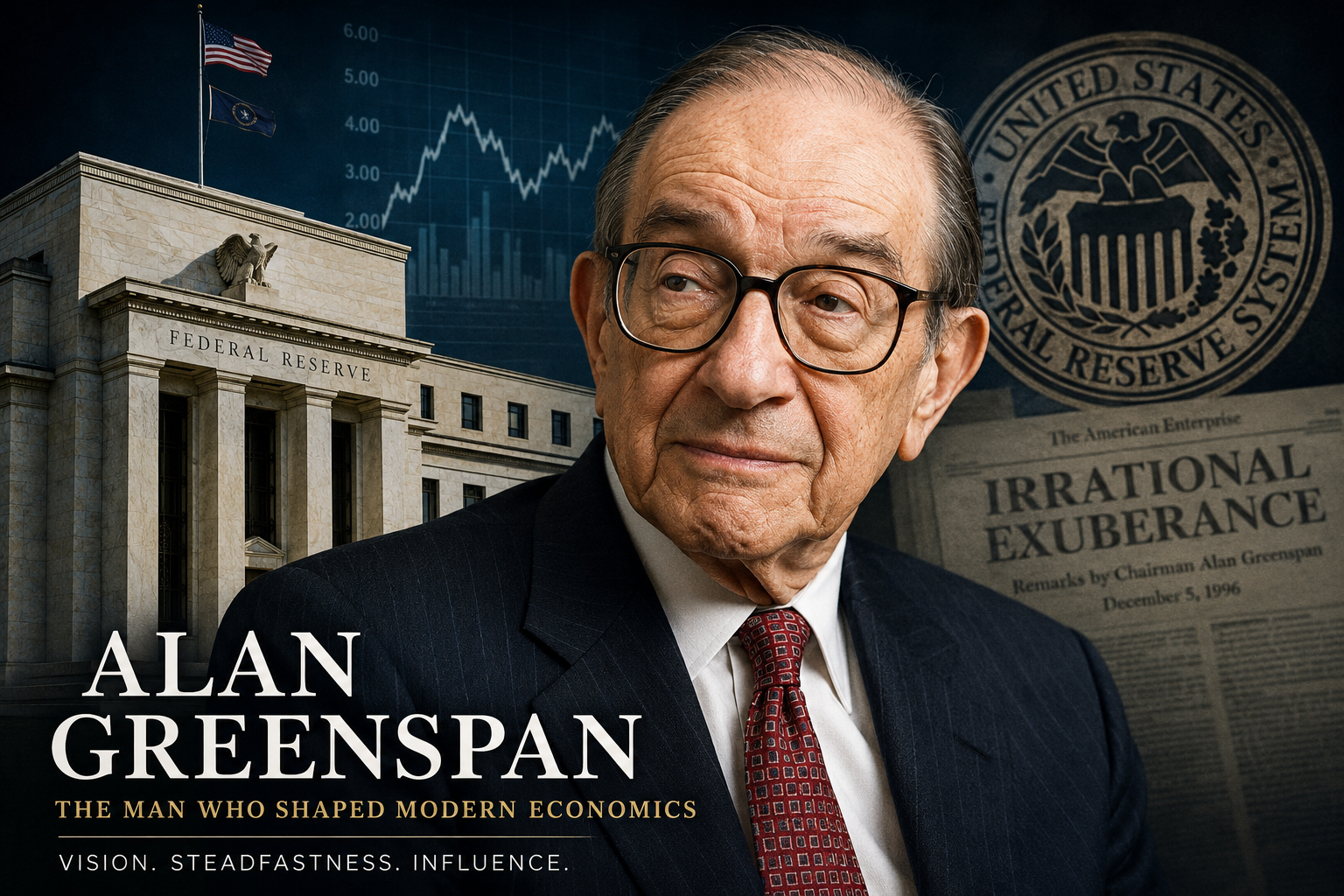
Alan Greenspan was one of the most influential economists and central bankers in modern history. Best known for serving as Chairman of the U.S. Federal Reserve from 1987 to 2006, he guided the American economy through stock market crashes, economic booms, financial crises, and rapid technological change.
During nearly two decades at the Federal Reserve, Greenspan became a trusted voice on interest rates, inflation, and economic growth. His decisions affected not only the United States but also financial markets and governments around the world.
Even after leaving office, his ideas continued to shape debates about banking regulation, monetary policy, and the role of central banks.
Quick Facts
| Category | Details |
|---|---|
| Full Name | Alan Greenspan |
| Date of Birth | March 6, 1926 |
| Place of Birth | New York City, United States |
| Nationality | American |
| Profession | Economist, Public Servant, Consultant |
| Famous For | Chairman of the U.S. Federal Reserve |
| Years as Fed Chair | 1987–2006 |
| Education | New York University (Economics) |
| Spouse | Andrea Mitchell |
| Known For | Monetary policy, interest rates, economic forecasting |
Early Life and Education
Alan Greenspan was born on March 6, 1926, in New York City. Growing up during the Great Depression gave him an early appreciation for how economic conditions can affect ordinary families and businesses.
As a young man, he studied economics and developed a strong interest in statistics and financial data. He attended New York University, where he earned degrees in economics and built the analytical skills that would define his career.
His curiosity about markets and public policy led him into consulting work, where he advised businesses on economic conditions and forecasting.
Career Before the Federal Reserve
Before becoming one of the world’s best-known central bankers, Greenspan worked in the private sector as an economic consultant.
He founded an economic consulting firm and advised corporations on investment decisions, market conditions, and long-term planning. His reputation for careful analysis attracted attention in Washington, where he later served in government advisory roles.
His growing influence eventually led to his appointment as Chairman of the Federal Reserve.
Becoming Federal Reserve Chairman
In 1987, President Ronald Reagan nominated Alan Greenspan to lead the Federal Reserve.
Only a few months after taking office, he faced one of his first major challenges: the stock market crash known as Black Monday, when markets around the world experienced sharp declines.
The Federal Reserve acted to provide liquidity and reassure investors, helping stabilize financial markets during a period of uncertainty.
This early response established Greenspan as a calm and data-driven leader.
Leading the U.S. Economy Through Major Events
Over the next 19 years, Greenspan oversaw monetary policy during several defining moments:
- The 1987 stock market crash
- The long economic expansion of the 1990s
- Rapid growth of the technology sector
- The Asian financial crisis
- The dot-com bubble and its collapse
- The aftermath of the September 11 attacks
- Early 2000s housing market developments
His decisions on interest rates influenced borrowing costs for businesses and consumers and affected investment decisions worldwide.
Why Alan Greenspan Became So Influential
As Federal Reserve Chairman, Greenspan controlled policies that affected inflation, employment, lending, and economic growth.
Investors around the world closely watched his speeches because even small comments could move stock markets, bond markets, and currencies.
His careful and often technical communication style became known as “Fedspeak,” where policymakers used measured language to avoid creating unnecessary market volatility.
The “Irrational Exuberance” Speech
One of Greenspan’s most famous moments came in 1996 when he warned about “irrational exuberance” in financial markets.
The phrase suggested that investors might be pushing stock prices beyond reasonable levels due to excessive optimism.
Although markets continued rising for several years afterward, the quote remains one of the most widely remembered statements ever made by a central banker.
Praise for His Leadership
Many economists credit Greenspan with helping the U.S. experience:
- Low inflation during much of the 1990s
- Strong economic growth
- Falling unemployment
- Increased productivity linked to technology
- Stable financial conditions during several international crises
Supporters viewed him as a pragmatic policymaker who adjusted interest rates based on changing economic conditions rather than ideology alone.
Criticism After the 2008 Financial Crisis
Greenspan retired in 2006, but his legacy was heavily debated after the global financial crisis of 2008.
Some critics argued that years of relatively low interest rates and confidence in financial markets encouraged excessive borrowing and risk-taking.
Others believed financial institutions should have faced stronger oversight before the housing bubble expanded.
Greenspan later acknowledged that some long-held assumptions about market self-regulation had proven less reliable than expected.
Global Influence
The Federal Reserve’s decisions often affect economies far beyond the United States.
During Greenspan’s tenure:
- Global investors watched U.S. interest rate changes closely.
- Emerging markets reacted to Federal Reserve policy decisions.
- International businesses adjusted investment strategies based on American monetary policy.
- Central banks in other countries studied the Fed’s approach to inflation and economic management.
His influence extended across Europe, Asia, Latin America, and other major financial centers.
Books and Public Speaking
After leaving public office, Greenspan remained active as an author and speaker.
He published books discussing economics, public policy, and lessons from his decades in government.
He also spoke at conferences and advised organizations on long-term economic trends.
Personal Life
Alan Greenspan married journalist Andrea Mitchell, a well-known television correspondent.
Outside economics, he enjoyed music and intellectual discussions and maintained an interest in public affairs throughout his life.
Friends and colleagues often described him as analytical, disciplined, and deeply committed to understanding economic data.
Lasting Legacy
Alan Greenspan’s influence on modern central banking remains significant.
His leadership demonstrated both the power and the challenges of monetary policy. While supporters praise his role in guiding long periods of economic expansion, critics continue to debate whether stronger financial regulation could have reduced later risks.
Regardless of differing opinions, Greenspan’s impact on global economics is undeniable.
Students of finance, policymakers, investors, and historians continue to study his decisions as they seek to understand how central banks shape economies.
Timeline of Major Milestones
- 1926: Born in New York City.
- 1950s: Established himself as an economic consultant.
- 1987: Appointed Chairman of the U.S. Federal Reserve.
- 1987: Managed the Fed’s response to the Black Monday market crash.
- 1996: Delivered the famous “irrational exuberance” warning.
- 1990s: Oversaw a period of strong economic expansion.
- 2001: Guided monetary policy after the September 11 attacks.
- 2006: Retired as Federal Reserve Chairman after nearly 19 years of service.
- Post-2006: Continued writing, speaking, and contributing to economic discussions.
- 2026: Passed away at the age of 100, leaving behind a lasting legacy in global finance.
Read More
Alan Greenspan Dies at 100: Former Fed Chair’s Legacy, Career and Economic Impact
China’s Gaokao 2026: Why 12.9 Million Students Took the World’s Toughest Exam
Who was Alan Greenspan?
Alan Greenspan was an American economist who served as Chairman of the U.S. Federal Reserve from 1987 to 2006 and became one of the most influential central bankers in history.
Why is Alan Greenspan famous?
He is best known for leading U.S. monetary policy through major economic events and for shaping discussions on inflation, interest rates, and financial markets.
How long did Alan Greenspan serve as Federal Reserve Chairman?
He served for nearly 19 years, from 1987 until 2006.
What is Alan Greenspan’s most famous quote?
His warning about “irrational exuberance” in financial markets is one of the most widely cited remarks in economic history.
What can students learn from Alan Greenspan’s career?
His career highlights the importance of economic analysis, data-driven decision-making, and understanding how public policy can affect millions of people.

Gulraj Ansari covers personal finance for Wall Street Sights, including retirement planning, credit, and everyday money decisions for U.S. readers.